
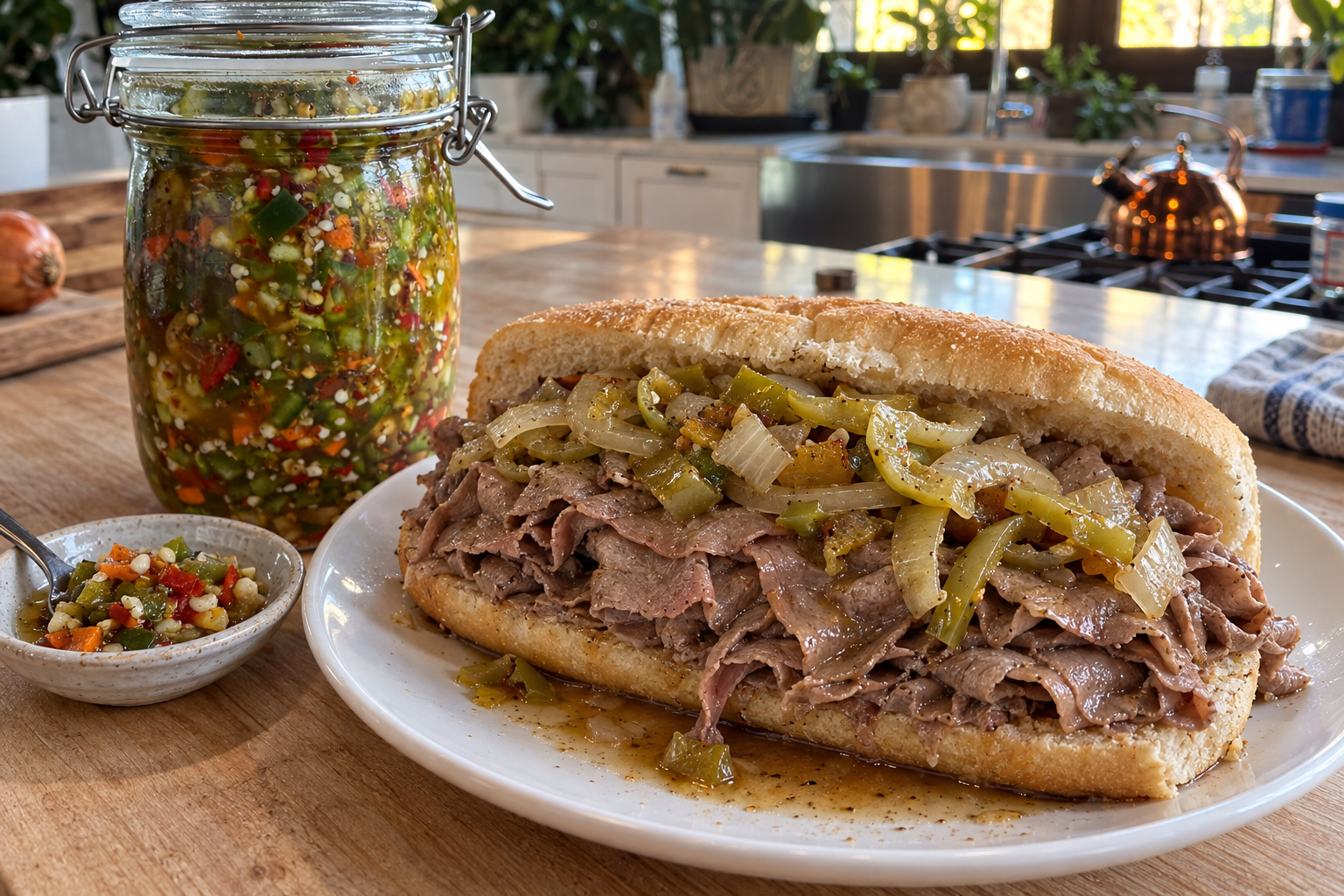

WHAT WE TESTED.
- Thin-sliced beef and house jus
- House-made giardiniera
- Sweet peppers and onions
- Beef and jus passed
- Toppings earned their place
- Bread remains TBD
If you read the last post, you know I left you with a nearly 18-pound bottom round roast sitting in my refrigerator.
Cooked.
Chilled.
Waiting for the slicer.
The jus was ready.
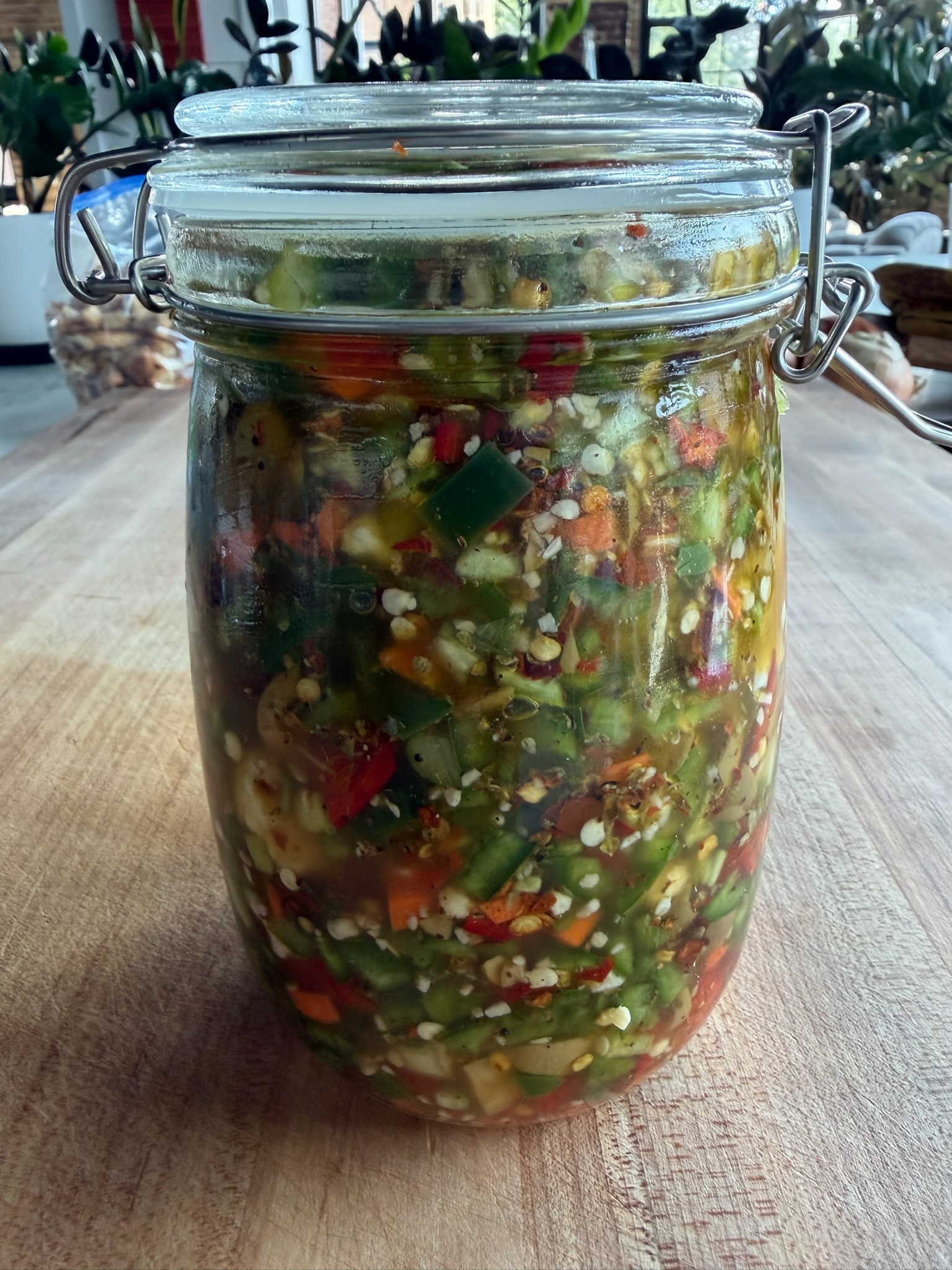
The homemade giardiniera had been brined, pickled and deemed sufficiently delicious—and sufficiently hot—by people with a much greater tolerance for spicy food than I have.
The sweet peppers and onions were ready.
Everything had gone according to plan.
But none of that really mattered yet.
I still hadn't eaten the sandwich.
It was time.
Paper Thin Means Paper Thin
One of the defining characteristics of a Chicago Italian beef is just how incredibly thin the meat is sliced.
We're not talking about carving a roast.
We're not even talking about what most people would consider thin deli meat.
We're talking paper thin.
That's also why chilling the roast overnight was so important. Trying to slice a warm, 18-pound piece of bottom round this thin would have been somewhere between difficult and impossible.
Cold and firm?
Much easier.
I started slicing.
And slicing.
And slicing.
That's when I noticed something that concerned me.
Maybe I Should Have Trimmed More
Before roasting the beef, I had made a deliberate decision not to aggressively trim it.
In fact, I trimmed very little.
My thinking was pretty simple: fat equals flavor, and I wanted some of that fat rendering during the long roast and contributing to the jus underneath.
But now that I was staring at paper-thin slices coming off the slicer, I started second-guessing myself.
Some slices had considerably more fat than I would normally want to see on a sandwich.
Maybe I should have trimmed more.
Another note for the next test?
Turns out, no.
Into the jus went the beef.
I brought everything to a very gentle simmer for just a few minutes.
And something interesting happened.
The fat rendered away.
Those slices that had looked a little too fatty coming off the slicer emerged from the jus looking almost entirely meaty.
Problem solved.
Actually, better than solved, because that fat hadn't been wasted. It had contributed flavor during the roasting process and then rendered from the incredibly thin slices when they were warmed.
Another lesson learned.
Warm It. Don't Cook It.
There's an important distinction here.
I wasn't trying to cook the sliced beef in the jus.
I was warming it.
That's it.
Remember, I intentionally pulled the roast at only 126°F during the initial cook because I knew these incredibly thin slices were going to spend additional time in hot jus.
If you've ever walked into a Chicago beef shop and watched the process, you've probably seen exactly what I'm talking about.
The sliced beef isn't being cooked to order.
It's sitting in warm jus on a steam table, waiting for someone to order a sandwich.
Tongs go in.
A mountain of wet beef comes out.
Onto the bread it goes.
That's the process I was trying to replicate.
So I resisted the temptation to boil the hell out of it.
A few minutes.
Low heat.
Just enough to warm everything through.
Then I tasted a piece.
Oh boy.
Now We Need Bread
Before I could assemble the first sandwich, there was one more critical ingredient.
The roll.
During my research, one name kept appearing over and over again:
Turano.
The Illinois bakery's rolls are practically synonymous with Chicago Italian beef, so I had tracked down a bag of six-inch Turano rolls for the experiment.
They're interesting rolls.
The bread itself is fairly hearty, but the outside has only the thinnest crust.
That makes sense for Italian beef. You don't want to bite through some massive, chewy artisan
crust while trying to keep paper-thin beef and peppers from shooting out the other end of the sandwich.
At least that was my thinking.
Everything was ready.
Time to build.
The Moment of Truth
I opened the first roll and grabbed the tongs.
In went a very generous quantity of warm beef.
Because if we're going to make a G&C version of a Chicago beef, nobody should have to search for the meat.
I poured just a little extra jus over the top.
Then came the giardiniera.
For sandwich number two, I repeated the process and topped it with my slowly cooked sweet peppers and onions.
Two sandwiches.
Two traditional toppings.
One very nervous guy standing over them.
I picked up the giardiniera version and took a bite.
Wow.
I mean…
WOW.
The beef was fantastic.
Tender.
Ridiculously tender.
The seasoning had penetrated enough to give it real flavor without making it taste like a heavily seasoned roast.
And the jus?
Perfect.
That was probably the part I had been most worried about.
With the bouillon, the seasoning from the roast, the rendered beef fat and all those hours of cooking, there were plenty of opportunities for it to become too concentrated or too salty.
It wasn't.
It tasted like beef.
Deep, rich, savory beef.
Exactly what I wanted.
Still Too Hot
Then the giardiniera kicked in.
Yep.
Still hot.
I had hoped that maybe the beef, bread and jus would tame it enough for me.
Nope.
I'm apparently just not destined to become a hot-giardiniera guy.
Fortunately, I have friends for that.
I handed the rest of that sandwich to one of my heat-loving taste testers and moved on to sandwich number two.
The sweet peppers.
This one was mine.
Now I Understand the "Sweet" Pepper
Something had been bothering me throughout my research.
Everywhere I looked, people referred to the other traditional Italian beef topping as sweet peppers.
Okay.
Makes sense.
Then I'd look at the recipe.
Green bell peppers.
Wait.
Green?
If we're trying to make sweet peppers, why wouldn't we use red peppers?
Or yellow?
Or orange?
Those are obviously sweeter.
Nevertheless, I decided to trust the tradition and used green peppers along with yellow onion.
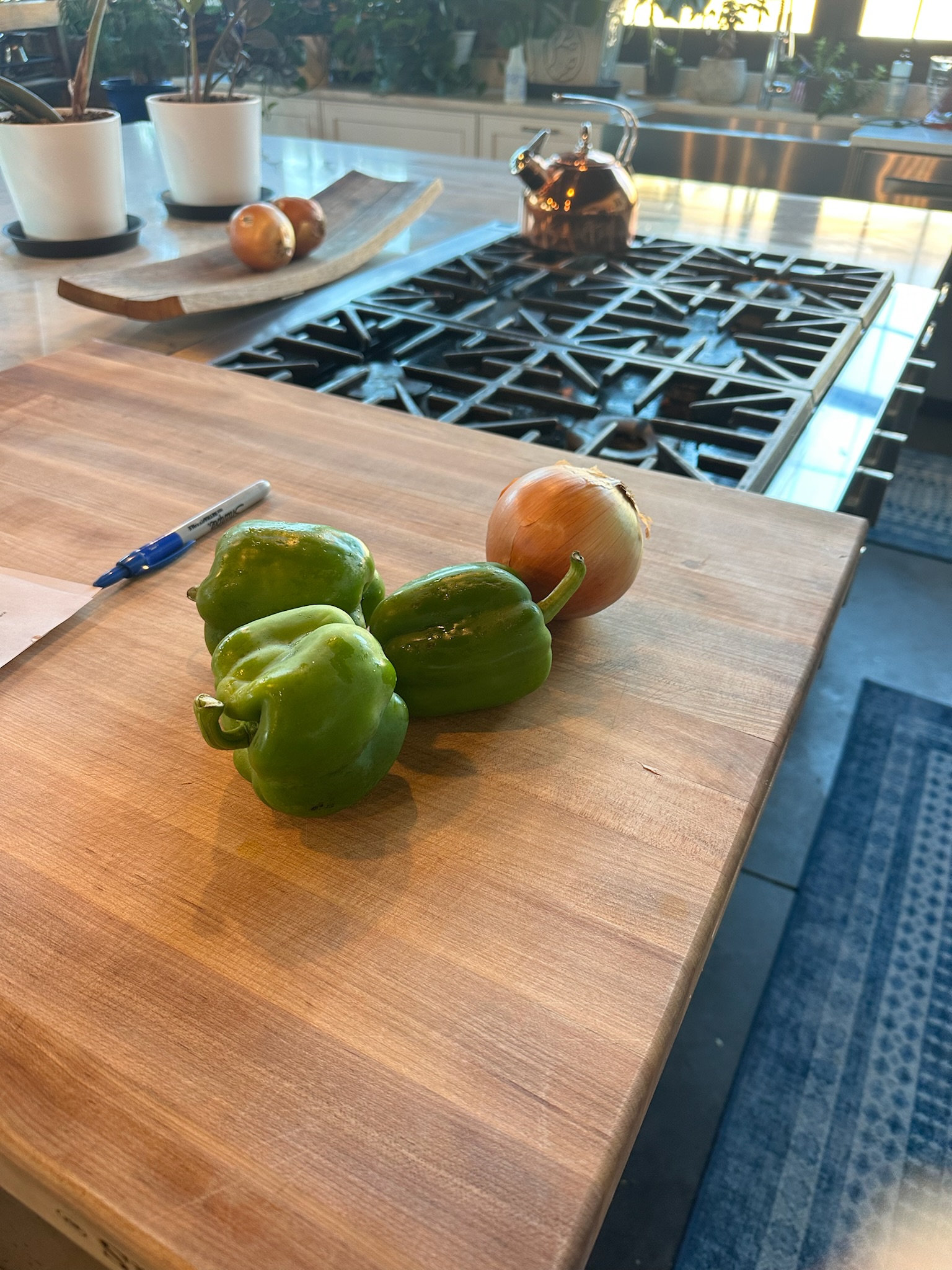
But I cooked them my way.
Very low.
Very slow.
For nearly an hour.
And now I understood.
They weren't sugary.
They weren't caramelized into some jammy topping that overwhelmed the beef.
They had simply developed the slightest natural sweetness.
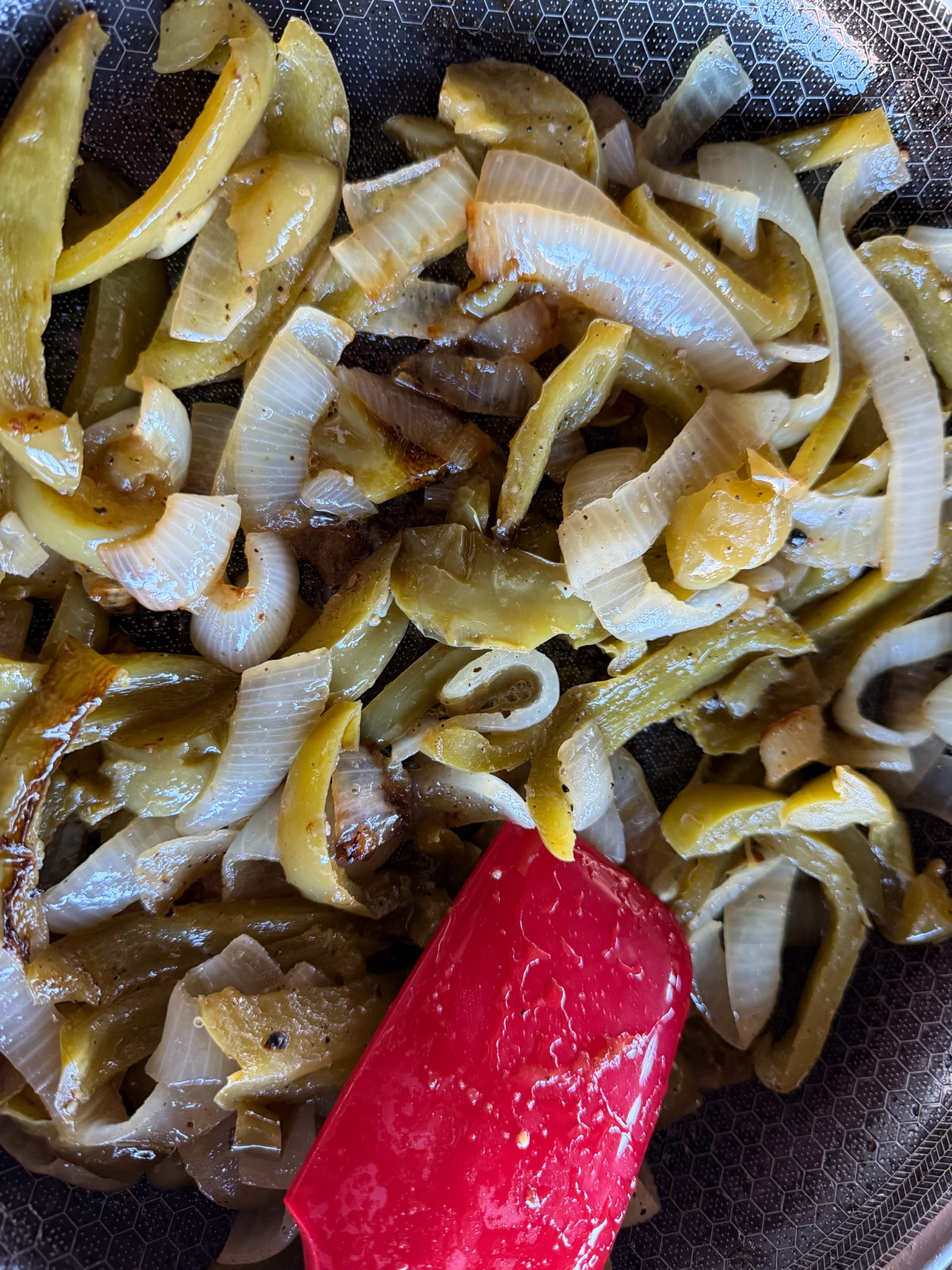
Just enough.
That subtle sweetness against the rich beef and savory jus was exactly what the sandwich needed.
Another bite.
Perfect beef.
Perfect jus.
Perfect peppers.
Another bite.
Yep.
I nailed it.
I'm Giving Myself an A+
I'm generally pretty hard on my own food.
That's kind of the point of all these experiments.
Good isn't enough.
I'm trying to figure out what could be better.
What needs another test?
What ingredient isn't quite right?
What technique needs to change?
This time?
A+.
The beef worked.
The seasoning worked.
The jus worked.
The giardiniera worked—even if I'm personally too much of a wimp to eat much of it.
The sweet peppers and onions worked.
This sandwich was a success across the board.
And as I sat down to write this post, something occurred to me.
I've roasted a lot of meat over the course of these Test Kitchen experiments.
I've made a lot of sandwiches.
I've changed seasonings.
Adjusted temperatures.
Changed cook times.
Swapped toppings.
Changed breads.
Reworked sauces.
Tested things again.
And again.
And again.
Thinking back through all of them, I realized something.
I've only nailed one other meat and sandwich combination on the first try.
I sat with that thought for a minute.
Maybe I'm actually getting better at this.
Maybe all these experiments aren't just producing recipes.
Maybe I'm learning.
That's a pretty satisfying realization.
Unfortunately, while I was busy congratulating myself, my sandwich was falling apart.
Houston, We Have a Bread Problem
Remember that Turano roll I spent all that time researching?
We need to talk about it.
A Chicago beef is generally ordered a few different ways.
You can get the beef relatively dry, meaning some of the jus is allowed to drain before the meat hits the bread.
You can get it wet.
Or you can go all the way and have the entire assembled sandwich dipped into the jus before it's handed to you.
I didn't even go that far.
For this first test, I took what I considered the middle-of-the-road approach.
Wet beef into the roll.
Then I ladled just a few tablespoons of additional jus over the top.
That was enough.
The clock started ticking.
The bread began to surrender.
Quickly.
Don't get me wrong.
I consumed that sandwich in what could probably be considered record time.
But even during that remarkably short journey from plate to stomach, the roll was breaking down.
By the end, structural integrity was becoming a serious issue.
That's not going to work.
Especially if I want someone to be able to order this thing fully dipped.
The Scientist Returns
Of course, there was only one reasonable response.
Make another sandwich.
My theory was that perhaps I could strengthen the roll without fundamentally changing what makes it appropriate for an Italian beef.
So I took a fresh Turano roll and lightly toasted the outside.
Not enough to make it crunchy.
Not enough to turn it into garlic bread.
Just enough heat to firm that incredibly thin exterior crust.
Then I rebuilt the sandwich.
Beef.
Jus.
Peppers.
More jus.
Bite.
Better.
Definitely better.
For about 30 to 60 seconds.
Then the jus won again.
The bread started breaking down.
Experiment over.
The Beef Passed. The Bread Didn't.
Here's the strange part.
I'm not disappointed.
Usually, when I get to this point in a Test Kitchen experiment and something isn't right, I hesitate to call the dish finished.
This time feels different.
I know the beef works.
I know the jus works.
I know the giardiniera works.
I know the sweet peppers and onions work.
Those were the difficult parts.
The sandwich itself is delicious.
I just need to find a bread capable of surviving it.
And my wheels are already turning.
Maybe it's a different roll.
Maybe it's a slightly different crust.
Maybe there's a way to strengthen the bread without making it chewy.
Maybe there's a bakery out there making exactly what I need.
I don't know yet.
But I'll figure it out.
This One Is Going on the Menu
So I'm doing something I don't normally do.
I'm calling this experiment a pass even though there's still one unresolved variable.
The bread is officially TBD.
Everything else?
Done.
The Chicago Beef has earned its spot on the G&C Sandwich Company menu.
That's a pretty big deal.
Especially considering where this experiment started: with a 17.88-pound hunk of bottom round and me wondering whether pulling a giant roast from the oven at 126°F was a terrible idea.
Turns out it wasn't.
The beef is right.
The jus is right.
The giardiniera is right.
The sweet peppers are right.
Now I just need a roll that can survive the experience.
And considering how much time I've already spent obsessing over French fries, pickles, coleslaw, mayonnaise, bacon and bread…
Does anyone really think I'm going to let a bun beat me?
Pass.
The Chicago Beef is going on the menu.
Bread TBD.
Stay tuned.
Tell us what you think.
The conversation links are coming soon.