
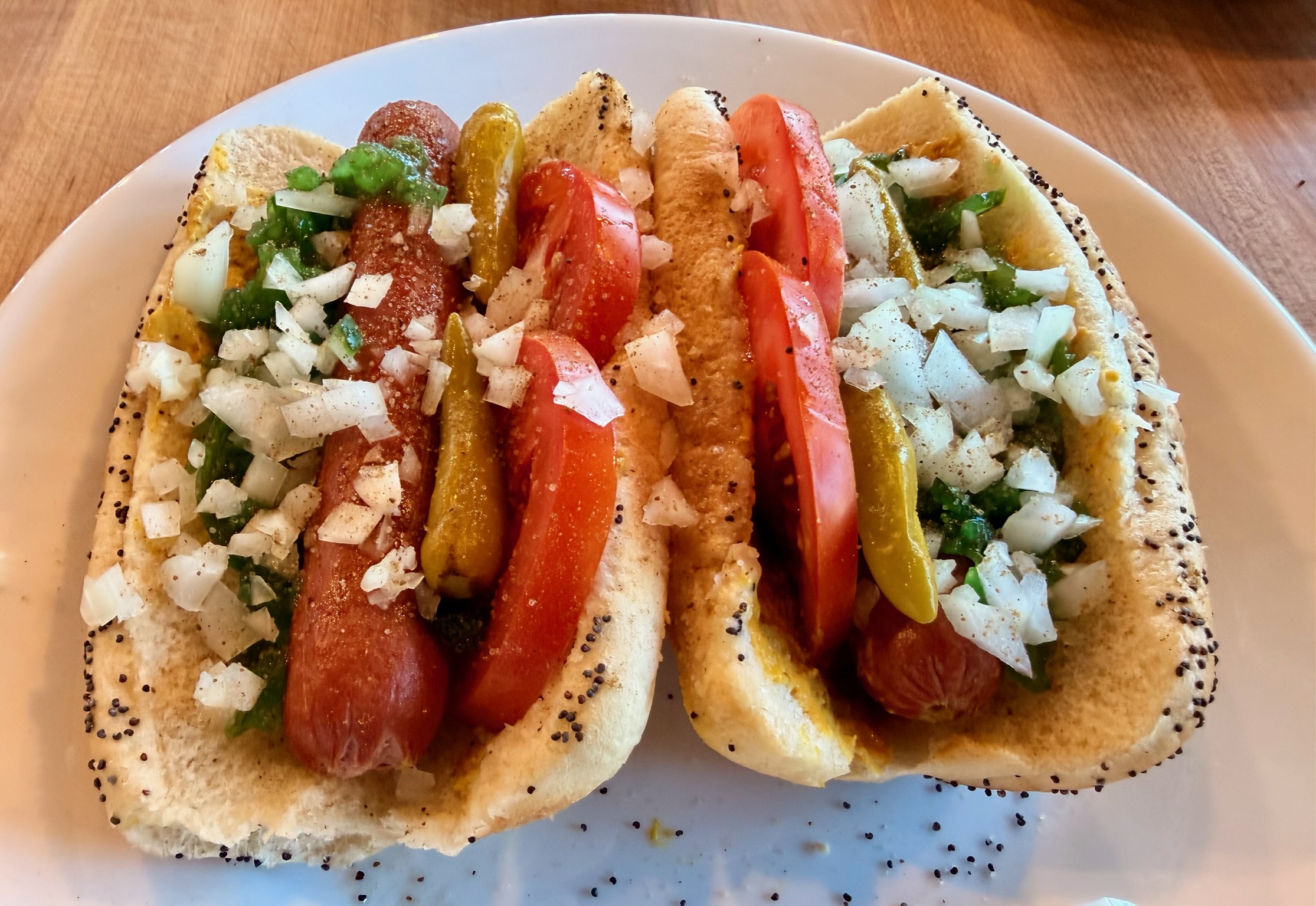

WHAT WE TESTED.
- Chicago, chili cheese and New York dogs
- Vienna Beef and Sabrett franks
- Two dogs per order
- All three dogs made the menu
- Cheese and onion-sauce refinements remain
- Build Your Own joins the lineup
Setting aside the fact that the title of this piece sounds like the start of a really good joke, a few days ago, I wrote an entire post about hot dogs.
Not gourmet hot dogs.
Not Wagyu hot dogs topped with truffle aioli and microgreens.
Hot dogs.
Specifically, three American classics I think belong on the eventual G&C Sandwich Company menu: a proper Chicago dog, a chili cheese dog inspired by the Detroit Coney tradition, and a
New York street-cart dog.
I did the research. I bought the dogs. I bought the buns. I made the sauces. I chopped what felt like an unreasonable quantity of onions.
Then it was finally time to stop reading about hot dogs and start eating them.
And I learned a few things.
First, all three were really good.
Second, the chili cheese dog won.
Barely.
And third, there is considerably more going on with a great hot dog than I probably would have admitted before starting this project.
First, the Ground Rules
I wanted this test to be reasonably faithful to the regional dogs I was trying to recreate.
For Chicago, I went with a 6:1 Vienna Beef all-beef frank—six dogs per pound, or about 2.67 ounces each.
For New York, Sabrett.
And I cooked them the way generations of hot-dog carts have done it: in hot water held around
170–180°F.
Yes.
The dirty-water method.
No, the water wasn't actually dirty.
The Chicago dog got its proper poppy-seed bun. The Coney-inspired chili cheese dog and New York dog got plain white buns.
And every bun was steamed.
For the home test, I used a steamer basket over about an inch of simmering water. The bun stays above the water, gets covered and steams for only about 20 seconds.
That's enough.
The transformation is surprisingly dramatic. The bun becomes warm, soft and pliable without becoming wet or gummy.
That little detail matters.
A lot.
Then it was time to build some dogs.
The Chicago Dog
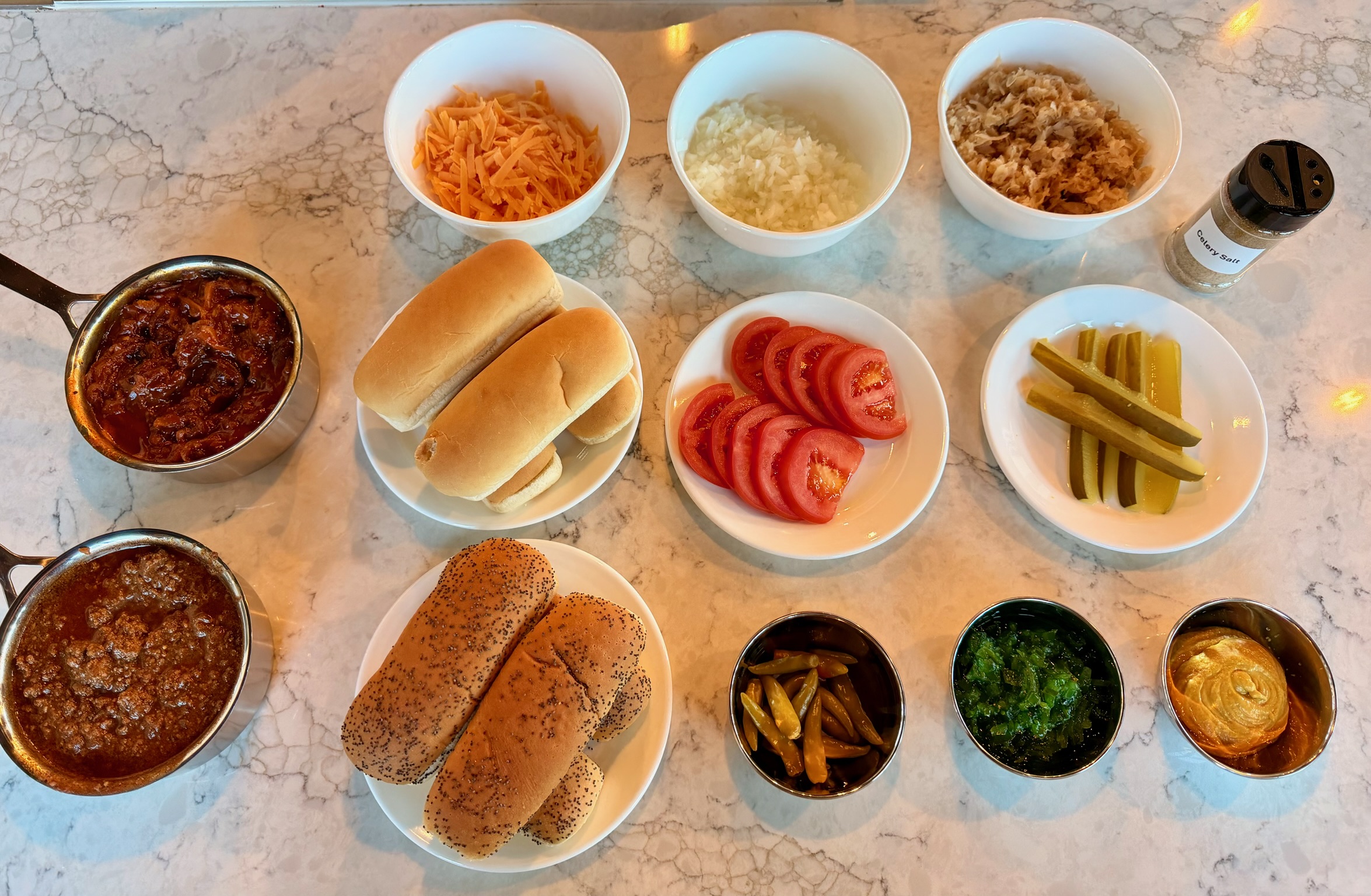
I've eaten dozens of Chicago dogs over the years, so this was probably the easiest test to judge.
There was a very specific target.
Vienna Beef frank.
Steamed poppy-seed bun.
Yellow mustard.
Bright-green relish.
Diced white onion.
Tomato.
Kosher dill pickle spear.
Sport peppers.
Celery salt.
Drag it through the garden and don't screw with it.
And that's exactly what I did.
The result?
Fantastic.
It tasted like Chicago.
Not "our interpretation" of Chicago. Not a chef-ed-up Chicago dog. Not a hot dog vaguely inspired by one.
It tasted like the dogs I've eaten from stands and street vendors around this city for years.
That's exactly what I wanted.
There was, however, one ingredient that confirmed something I've suspected for a long time.
I don't particularly like sport peppers.
There. I said it.
I understand why they're there. They provide acid, heat and another layer of flavor against the richness of the beef frank. And they certainly gave the finished dog a little kick.
But there was also a textural issue for me.
A Chicago dog has this wonderful collection of relatively substantial vegetables—the tomato, pickle, onion and relish—and then you encounter this comparatively thin, almost papery pepper skin.
It has always felt slightly out of place to me.
So am I removing the sport peppers from the G&C Chicago dog?
Absolutely not.
That's the interesting lesson.
I'm not developing Doug's Preferred Version of a Chicago Dog.
I'm developing a Chicago dog.
And sport peppers belong on it.
People who don't like them can take them off.
Including me.
Sometimes recipe development is about deciding what to change.
Sometimes it's about recognizing what you shouldn't.
Then Came the Coney Sauce
This was the recipe I was probably most curious about.
I knew from the beginning that I didn't want conventional chili.
Hot-dog chili—or Coney sauce—is a different animal.
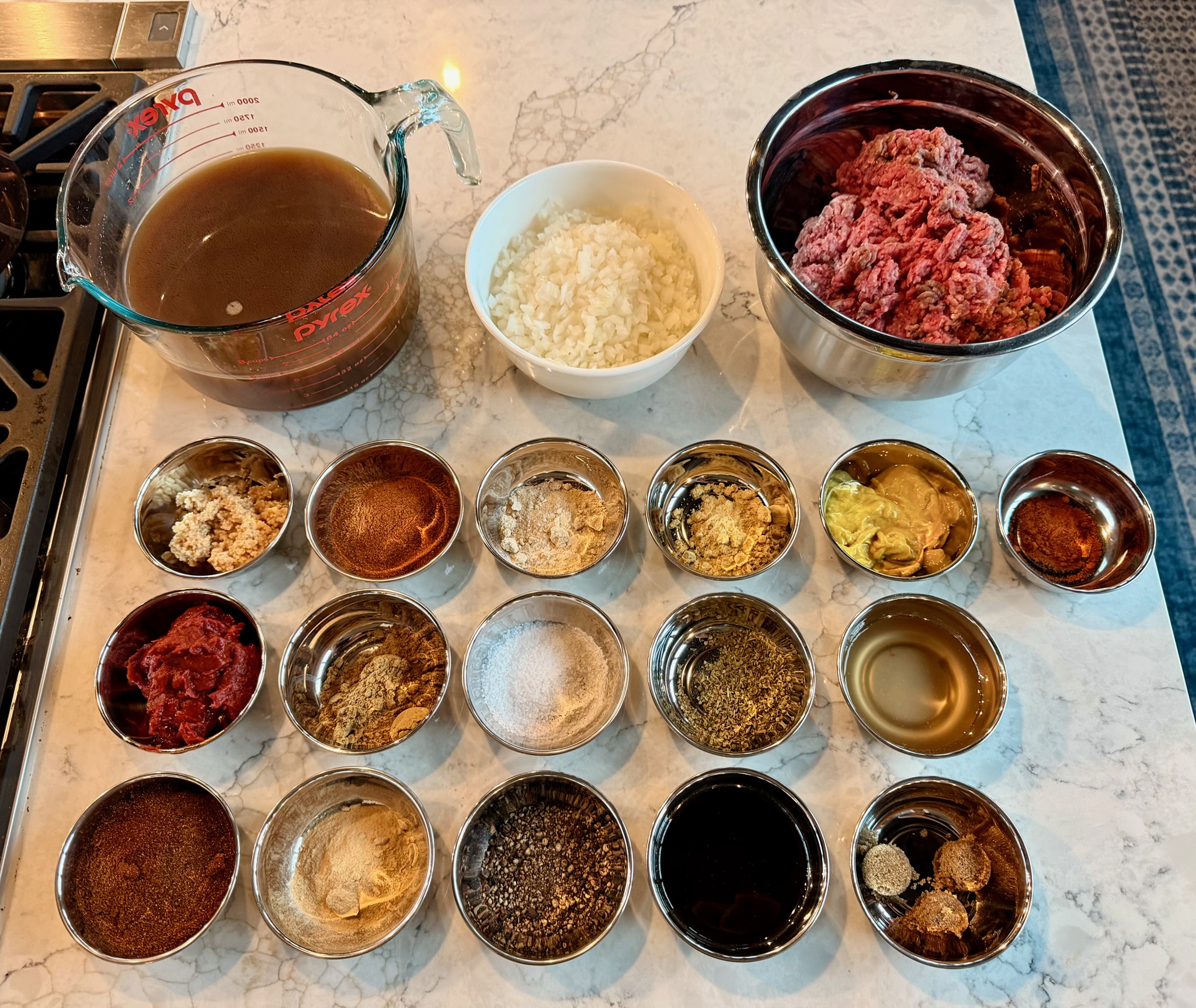
I started with a pound of 80/20 ground beef and two cups of cold beef stock.
And then I did something that feels fundamentally wrong if you've spent years cooking ground beef.
I didn't brown it.
At all.
The raw beef went directly into the cold stock.
Then I attacked it with a whisk.
Seriously.
I whisked the hell out of it.
The goal was to break that beef into extremely fine particles before it ever had an opportunity to seize into larger crumbles.
That turned out to be one of the most important steps in the entire recipe.
Once the beef was thoroughly dispersed, I added finely minced onion and garlic, brought everything to a gentle simmer, and eventually added tomato paste, chili powder, paprika, cumin, garlic and onion powders, mustard, Worcestershire, cider vinegar, a little brown sugar, cayenne and the rest of the seasonings.
Then I let it slowly cook down.
What emerged was exactly what I had been looking for.
Deeply beefy.
Rich.
Finely textured.
Thick enough to sit on a hot dog.
And absolutely delicious.
I was so excited about it that I did what seemed completely logical at the time.
I filled a bowl.
Grabbed a spoon.
Sat down.
And discovered something fascinating.
This is not very good chili.
Don't misunderstand me.
It tasted great.
But eating an entire bowl made it immediately obvious how rich and concentrated the sauce really was. There aren't beans, chunks of tomato or vegetables to break things up.
It doesn't have the texture or balance you expect when you're sitting down to eat a bowl of chili.
And that's precisely why it works so beautifully on a hot dog.
That may have been my favorite lesson of the entire test.
A great topping doesn't necessarily have to work as a standalone dish.
It has a job.
This sauce's job is to deliver an intensely concentrated hit of seasoned beef that can stand up to a frank, mustard, onion and cheese without overwhelming the entire thing.
And it does that job extremely well.
I'm calling the Coney sauce solved.
The Winner
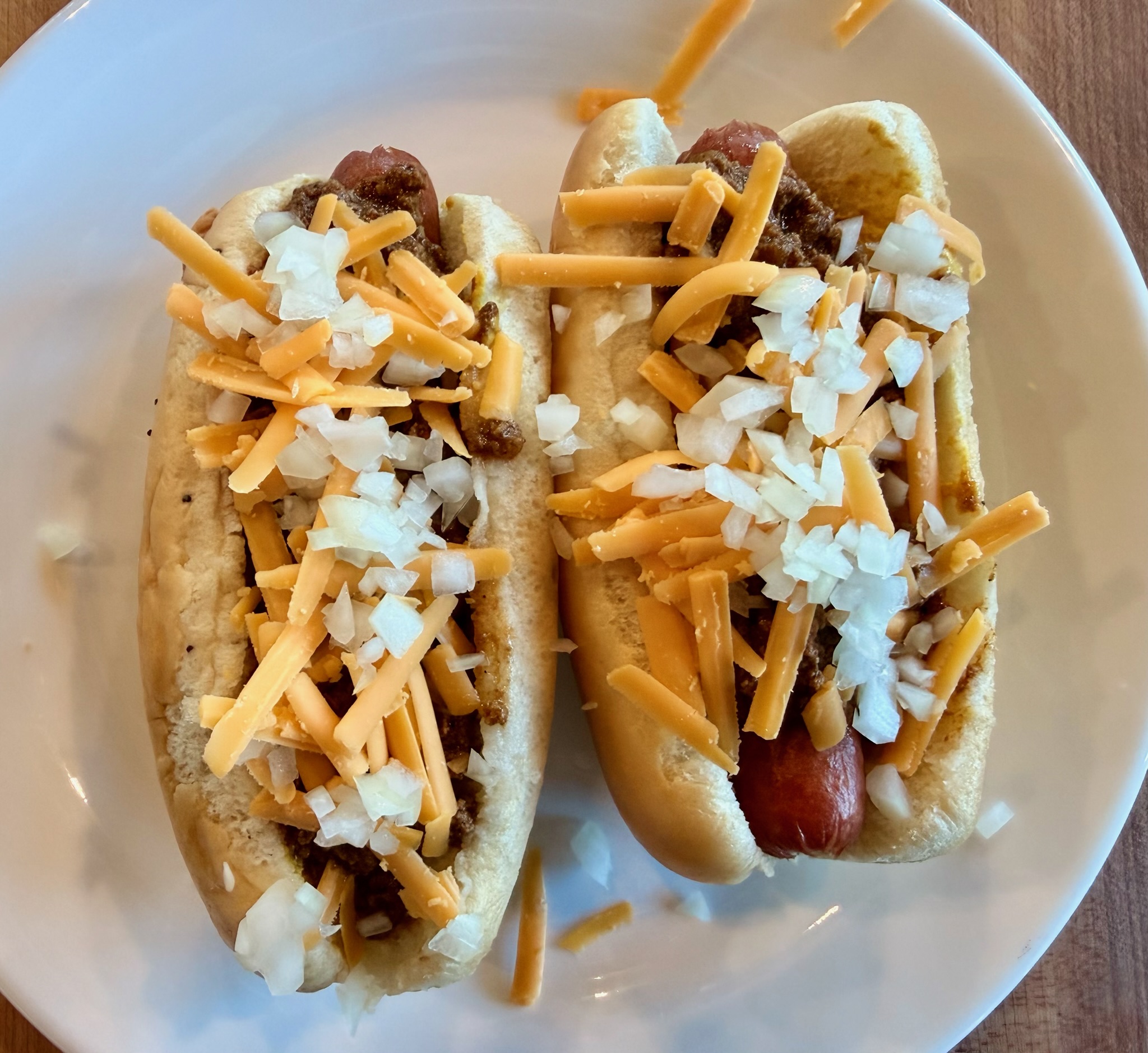
The finished chili cheese dog was simple:
Steamed white bun.
Vienna Beef frank.
Yellow mustard.
Diced white onion.
Coney sauce.
Shredded Wisconsin sharp cheddar.
And it was my favorite dog of the test.
By approximately half a percentage point.
I'm serious.
The Chicago dog was that close.
But the chili cheese dog had something about it that kept pulling me back for another bite.
The beef-on-beef combination certainly isn't subtle, but the mustard and raw onion cut through the richness, while the cheese rounds everything out.
The Coney sauce was exactly what I wanted.
The cheese?
That's where I think there is still some playing around to do.
I used shredded sharp cheddar. It was good, but I don't think the sharpness added much to the overall composition. There is already a lot happening between the seasoned
beef sauce, frank, mustard and onion.
Next time I'll probably try a milder cheddar.
I'm also going to experiment with a cheese sauce.
That could be dangerous.
A proper Wisconsin cheddar sauce flowing over that Coney sauce could push the whole thing in a very different direction.
It could also turn a really good hot dog into an excessive mess.
That's why we test.
For now, shredded cheddar remains the baseline.
But—and this distinction becomes important later—the dog itself is done.
I'm just deciding what cheese deserves to sit on top of it.
And Then New York Surprised Me
Of the three dogs, the New York street-cart dog was probably the one I had the least personal connection to.
I've eaten them in New York, of course, but I don't have the same history with them that I do with Chicago dogs.
And there's another problem.
I don't particularly like sauerkraut.
This menu-development process keeps forcing me to cook things I supposedly don't like.
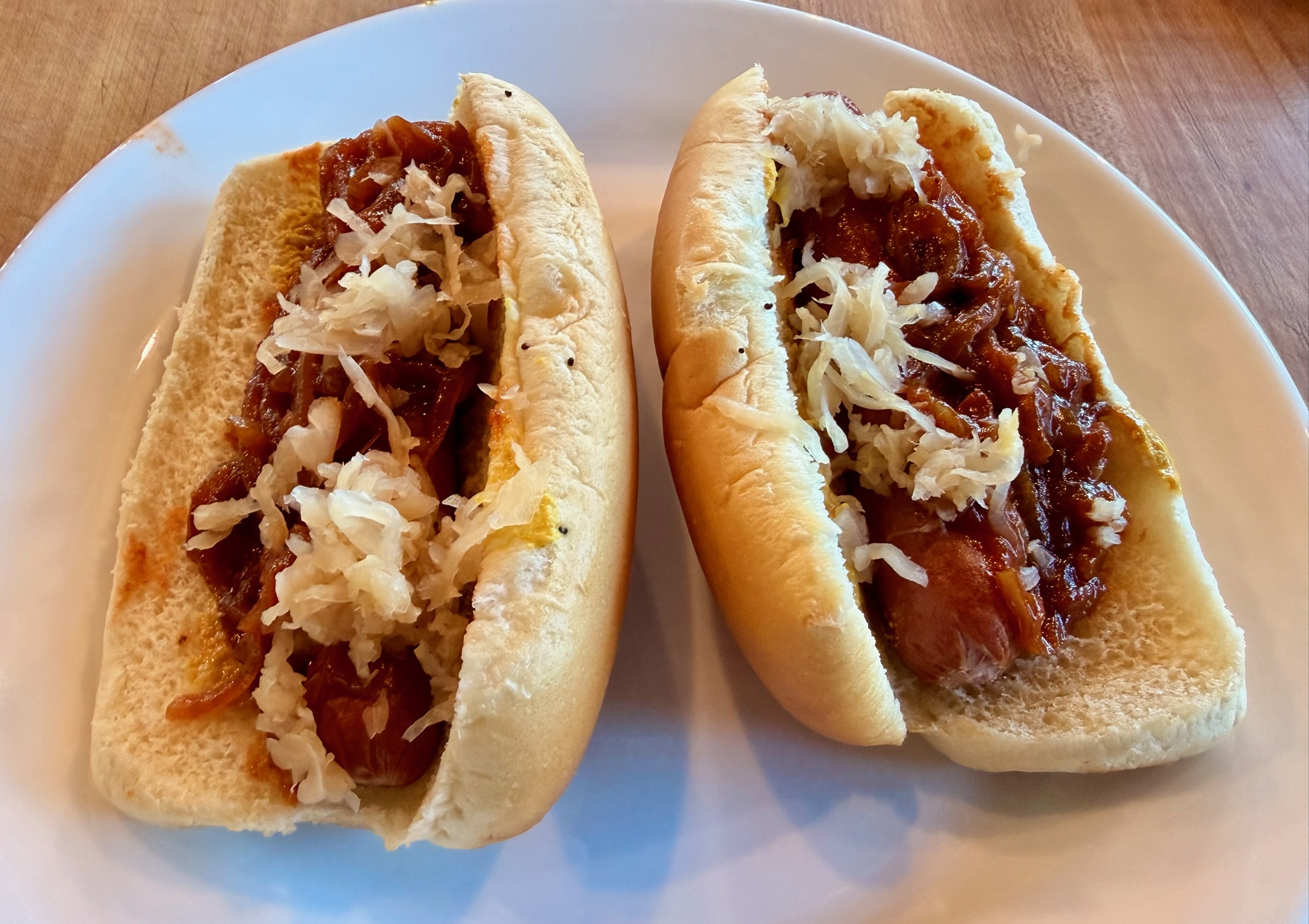
The New York dog started with a Sabrett all-beef frank on a steamed white bun.
Then came a relatively small amount of mustard, warm and well-drained sauerkraut, and the ingredient I was most interested in testing:
The red onion sauce.
That sauce was fantastic.
Not just good on the hot dog.
Fantastic by itself.
I started with thinly sliced yellow onions and deliberately avoided caramelizing them. The goal wasn't deep, brown, French-onion sweetness. I wanted the onions softened but still identifiable.
Then came tomato paste, water, ketchup, cider vinegar, brown sugar, Worcestershire and seasonings.
The original plan called for simmering it about 30–40 minutes.
I think that's too short.
The flavor was already terrific, but I think this sauce will benefit from a much longer, gentler cook—probably closer to 90 minutes—with a little water added periodically if
necessary.
There's one other change I'm making.
The onions need to be shorter.
Thin rings look nice, but on a hot dog they can become stringy. Take one bite and there's a chance you're dragging half an onion off the dog with you.
Not ideal.
Next batch, I'll still slice the onions thinly, but I'll quarter the rings.
Same onion.
Same flavor.
Much better bite.
That's not really a recipe change.
It's refinement.
And that's exactly the kind of tiny adjustment this test kitchen exists to discover.
About That Sauerkraut
I still don't like sauerkraut.
But I liked it on this dog.
Quite a bit, actually.
And I think I understand why.
Taken by itself, sauerkraut has never done much for me. But on this dog it isn't supposed to be the star.
The beef frank brings richness and salt.
The mustard brings heat and acidity.
The onion sauce brings sweetness, tomato, spice and another layer of acidity.
And the sauerkraut cuts through everything.
The combination makes sense in a way the individual ingredient doesn't necessarily make sense to me.
That's another useful lesson.
When you're developing a sandwich—or a hot dog—you can't evaluate every ingredient exclusively by asking whether you'd want to eat a bowl of it.
Which, apparently, I needed to learn twice in the same afternoon.
Don't eat a bowl of Coney sauce.
Don't hand me a bowl of sauerkraut.
Put both where they belong and suddenly I'm very happy.
What About the Franks?
One of my original questions was whether carrying different regional hot dogs would be unnecessarily complicated.
After this test, I think I'm okay with it.
The Vienna Beef frank was exactly right for Chicago.
It also worked beautifully underneath the Coney sauce.
And the Sabrett gave the New York dog the character I was looking for.
Could I simplify purchasing and inventory by choosing one frank for everything?
Absolutely.
But if G&C Sandwich Company is going to celebrate these regional American foods, I think there's something worthwhile about respecting the ingredients associated with them
when those ingredients actually make a difference.
Chicago gets Vienna Beef.
New York gets Sabrett.
The chili cheese dog gets Vienna.
I'm comfortable with that.
And Yes, We're Serving Two
One decision from the original test plan survived completely intact.
Two dogs per order.
The 6:1 franks were the right size—about 2.67 ounces each. They're substantial without becoming those enormous novelty hot dogs where the proportions stop making sense.
But one isn't lunch.
Two are.
Order the Chicago and you get two proper Chicago dogs.
Order the Chili Cheese and you get two loaded chili cheese dogs.
Order the New York and you get two street-cart dogs.
Now it feels like a G&C meal.
One More Addition
I also think there should be a fourth option on the menu.
Build Your Own.
This isn't going to become one of those places with 47 toppings and a flowchart.
We'll already have the ingredients on the line.
Pick a bun.
Pick a dog.
Then choose from ketchup, yellow mustard, relish, diced onion, shredded cheddar and Coney sauce.
Want ketchup on your hot dog?
Go for it.
Just don't ask me to put it on the Chicago dog.
I have standards.
So, Where Are We?
They made the menu.
All three of them.
And that's actually a much bigger deal than it sounds.
If you've been following these test-kitchen experiments, you know that's not normally how this works.
The Reuben took multiple rounds.
The fries have taken multiple rounds.
Pickles, sauces, mayonnaise, cooking methods, portion sizes—almost everything I've worked on has needed a second test.
Or a third.
Sometimes a fourth.
That's the whole point of having a test kitchen.
You make something.
You eat it.
You figure out what's wrong with it.
You change one or two variables.
You make it again.
I've become pretty comfortable with the idea that the first version probably isn't going to be the final version.
Apparently, hot dogs didn't get that memo.
Because for the first time since I started seriously developing the G&C Sandwich Company menu, three test-kitchen recipes went from concept to menu in a single round.
That's a little shocking.
There are still tiny adjustments to make.
I'm going to cut the onions shorter and cook the New York onion sauce longer.
I'm going to test a milder cheddar on the chili cheese dog, and I'm curious enough about a Wisconsin cheddar cheese sauce that I have to try it.
We'll eventually dial in exact topping weights, holding procedures and assembly.
But those aren't do-over-the-recipe changes.
That's refinement.
The dogs themselves are done.
The Chicago Dog made the menu.
The Chili Cheese Dog made the menu.
The New York Street-Cart Dog made the menu.
And, yes, Build Your Own is coming with them.
That's four hot-dog options on the eventual G&C Sandwich Company menu.
Not bad for one afternoon.
Three Dogs. Three Places. One Surprisingly Easy Test.
I went into this expecting the same process I've experienced with almost everything else.
Make them.
Take notes.
Find the problems.
Change the recipes.
Go shopping again.
Make them again.
Repeat until I stop finding things that annoy me.
Instead, I sat down after the test and realized something unusual.
I didn't have any real problems to fix.
That's not to say every detail is permanently locked.
The cheese can change.
The onions can be cut differently.
The sauce can simmer longer.
Eventually I'll have to translate everything I've done in my home kitchen into procedures that work during a restaurant lunch rush.
But none of those things changes what these dogs are.
And that's the important distinction.
The whole point of the G&C test kitchen isn't to endlessly tinker with food just for the sake of tinkering.
It's to figure out what I want to serve and then keep testing until I know it's ready.
Apparently, every once in a while, that happens on the first try.
These are ready.
The hot dogs officially made the G&C Sandwich Company menu.
That makes this a first.
No second test.
No third test.
No fourth test.
No week of wondering what went wrong and which variable I need to change next.
I bought a whole lot of hot dogs.
I made a whole lot of hot dogs.
I ate entirely too many hot dogs.
And somehow, on the first try, we got three keepers.
I'll take the win.
Tell us what you think.
Join the conversation on Facebook, X or Substack.