
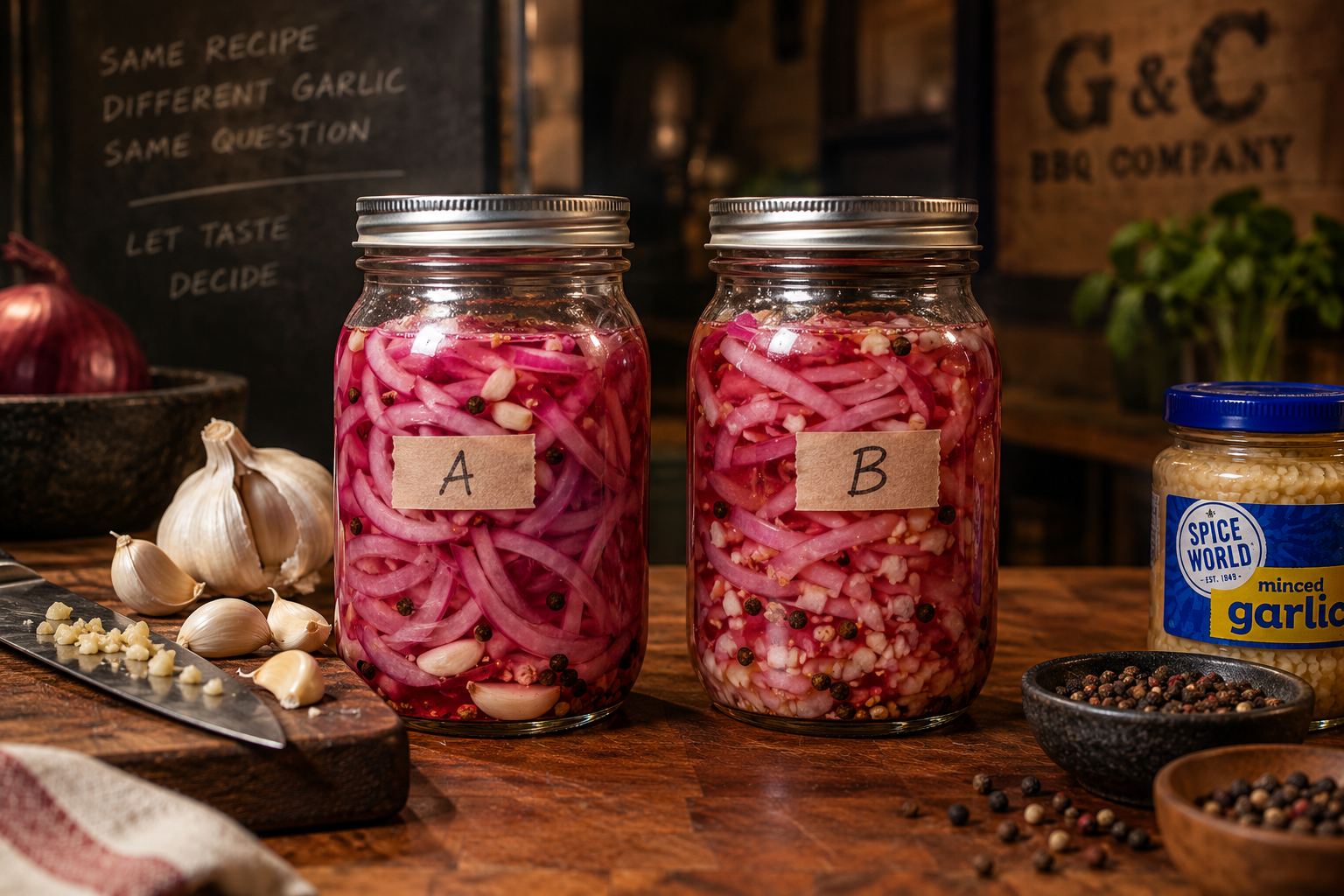

WHAT WE TESTED.
- Two otherwise identical batches of pickle spears
- Freshly chopped garlic vs. jarlic
- Same cucumbers, brine, and spices
- Blind taste test after 24 hours
- 3 tasters
- All 3 tasters independently preferred jarlic
- A slightly softer initial punch
- More rounded garlic flavor that lingered longer
I genuinely thought we were done.
After finally settling on cutting our cucumbers into spears instead of chips, I figured the pickle project was headed toward the finish line. The spears looked better, felt more substantial next to a sandwich, and delivered the satisfying crunch I had been chasing from the beginning.
Simple enough.
Except that's never how recipe development seems to work.
My engineering brain has an unfortunate habit of asking one more question just when I think an experiment is over.
This time the question was about garlic.
For every batch of pickles I've made so far, I've used freshly peeled and chopped garlic cloves. That's what every respectable recipe seems to call for. Fresh ingredients. Fresh flavor. End of discussion.
Or is it?
As I stood there chopping garlic for what felt like the hundredth time, I started wondering whether I was actually maximizing the thing I cared about most.
The garlic flavor in the brine.
My theory was surprisingly simple. Pickling is all about extraction. The brine pulls flavor from everything you put into it. If that's true, then wouldn't exposing more garlic surface area to the brine create a better pickle?
That led me to the ingredient many cooks quietly keep in their refrigerators but rarely brag about.
Jarlic.
Yes, the minced garlic that comes in a jar.
It's already peeled. It's already finely chopped. And compared to hand-chopped garlic, it has dramatically more exposed surface area. If my theory was right, every tiny piece of garlic would have an opportunity to share its flavor with the brine.
There was only one way to find out.
I made two identical batches.
The cucumbers were the same.
The brine was the same.
The spices were the same.
The only difference was the garlic.
One batch received freshly chopped cloves.
The other received jarlic.
Twenty-four hours later, the tasting began.
Even better, we made it a blind taste test.
Three people sampled both pickles without knowing which batch they were eating.
The result wasn't even close.
All three of us independently chose the batch made with the jarlic.
Interestingly, the difference wasn't dramatic. This wasn't one pickle exploding with garlic while the other tasted bland.
Instead, it was more refined.
The jarlic batch delivered a slightly softer initial punch. Then, instead of disappearing, the garlic flavor lingered on your palate just a little longer. It was more rounded, more integrated with the brine, and somehow more enjoyable from beginning to end.
Sometimes recipe development isn't about finding a completely different flavor.
Sometimes it's about making a great flavor just a little better.
Would I have ever guessed that a jar of minced garlic would outperform fresh garlic in a blind taste test?
Not a chance.
But that's exactly why I keep doing these experiments.
Every assumption deserves to be tested.
Sometimes the ingredient that feels like a shortcut turns out to be the better tool for the job.
For now, it looks like our "Kick You in the Head" pickle spears have found another small but meaningful improvement.
One more experiment complete.
...At least until my brain thinks of the next question.
Tell us what you think.
Join the conversation on Facebook, X, or Substack.