
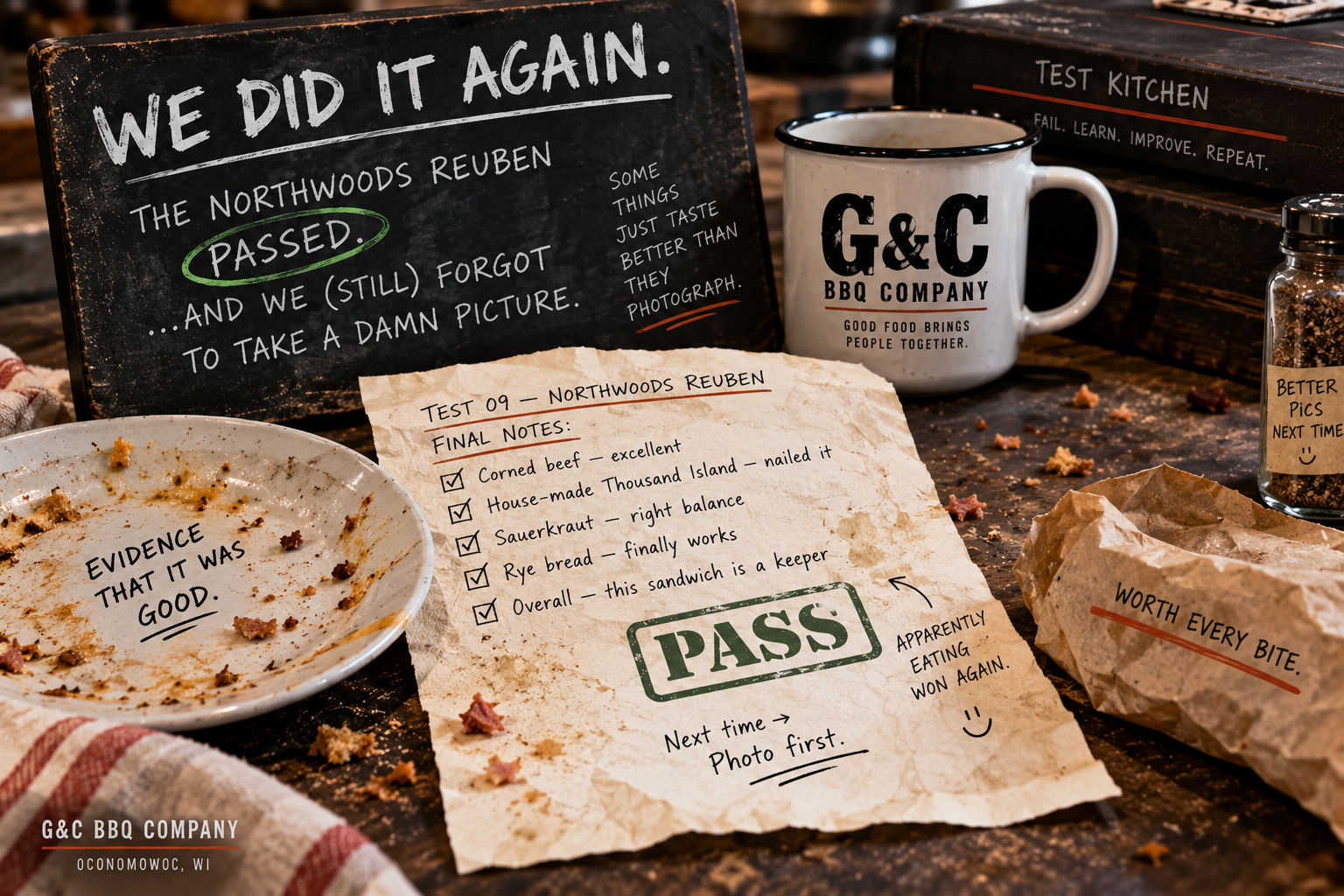
WHAT WE TESTED.
- 2 large slices of rye bread
- A pile of corned beef - sliced to 1mm this time
- House made Thousand Island
- Swiss cheese
- The beef was perfect
- The dressing was fantastic
- The toasted rye did the trick
THE NORTHWOODS REUBEN · PART 2 · READ PART 1
One of the things I've learned throughout this entire G&C test kitchen adventure is that solving one problem almost always creates another.
Take The Northwoods Reuben, for example.
If you read my last post, you know I was thrilled with the corned beef.
I was thrilled with the homemade Thousand Island dressing.
I wasn't thrilled with the bread.
The sandwich tasted fantastic, but something was missing.
I wanted that unmistakable buttery crunch on the outside that makes a great grilled sandwich so satisfying. Instead, the bread browned unevenly, the sandwich wanted to fall apart while I was assembling it in the pan, and by the time everything came together, the bread had absorbed more moisture than I wanted.
The sandwich was good.
It just wasn't G&C good.
So I spent the afternoon doing something that probably sounds incredibly boring to most people.
I tested bread.
Over.
And over.
And over.
Eventually, I cracked the code.
Or at least my code.
The solution wasn't complicated.
In fact, it was almost embarrassingly simple.
First, lightly toast both slices of rye bread in the toaster.
Not enough to make them crunchy.
Just enough to begin drying the surface.
Then brush one side of each slice with a very thin coat of melted butter.
Butter side down into a hot pan.
Just a few seconds.
That's it.
The result was exactly what I'd been chasing.
The outside developed that beautiful buttery crunch I wanted, while the lightly toasted interior created something I hadn't really thought about before.
Armor.
That slight toast on the inside acted as a moisture barrier, keeping the bread from becoming soggy the moment I piled on the warm corned beef, melted Swiss cheese, homemade Thousand Island dressing, and eventually, sauerkraut.
It completely changed the sandwich.
Not with a new ingredient.
Not with an expensive piece of equipment.
Just with a different way of preparing the bread.
That discovery also made me realize something much bigger.
I've been thinking about bread all wrong.
Until now, I'd been asking a fairly simple question:
"What's the right bread for this sandwich?"
Now I think there's a better question.
"What's the right way to prepare that bread for this sandwich?"
Those aren't the same thing.
The Northwoods Reuben benefits from buttery toastiness on the outside.
But what about The Oconomowoc Brisket Stack?
That oversized brioche bun doesn't necessarily need a crunchy exterior.
What it really needs is a lightly toasted interior that creates a barrier between the bread and all those wonderful juices coming from the brisket.
Different sandwich.
Different goal.
Different technique.
And now I'm wondering…
What about the pulled pork sandwich?
The grilled cheese?
The Philly?
Have I been making assumptions about bread that deserve another look?
If there's one thing this test kitchen has taught me, it's that assumptions are meant to be challenged.
Sometimes they survive.
Sometimes they don't.
Either way, the sandwich gets better.
So, fair warning.
You're probably about to hear more about bread than you ever wanted to.
And honestly…
I'm pretty excited about that.
P.S. - The soaking debate…
Oh, and when it comes to the soak v. not soak the beef before cooking, the answer was surprisingly uneventful. I sliced and tasted the unsoaked brisket side-by-side with the version that had spent two hours in cold water, and there really wasn't much difference. If you forced me to pick one, the unsoaked version was perhaps slightly saltier—but not unpleasantly so. In fact, my brain translated that little bit of extra salt into something closer to a richer, more pronounced corned beef flavor. It tasted just a touch more like what I wanted corned beef to taste like. Was the difference dramatic? Absolutely not. Could I reliably identify the soaked version in a blind taste test? I'm not sure I could. But based on this experiment, I'm having a hard time finding a reason to add two hours of soaking to the process. Sometimes an experiment teaches you a new technique. Sometimes it teaches you that you can skip one.
Tell us what you think.
The conversation is open. Pick the place you already use.