
The Search for the Perfect Philly Cheesesteak
There are some sandwiches you can play with.
And then there are sandwiches where you need to understand the rules before you start breaking them.
The Philly cheesesteak is definitely the latter.
As I've been developing the menu for G&C Sandwich Company, one sandwich was never really in question. There was going to be a cheesesteak.
I love them.
But I don't want to make the generic Midwestern version of a "Philly" — sliced beef buried under peppers, mushrooms, onions and cheese on whatever hoagie roll happens to be available.
I want to understand what makes a great Philadelphia cheesesteak a Philadelphia cheesesteak.
Then I want to see if we can recreate it in Oconomowoc.
And like most things in this test kitchen, that means we're going to have to do some experimenting.
First, a Little History
The story of the cheesesteak starts in South Philadelphia in 1930.
Pat Olivieri was operating a hot dog stand when, according to the story, he decided he wanted something different for lunch. He got some beef from a butcher, cooked it on his hot dog grill, put it on an Italian roll with onions and was about to eat it when a cab driver noticed what he was having.
The cabbie wanted one.
And apparently he had some pretty good business advice:
Forget the hot dogs. Sell these.
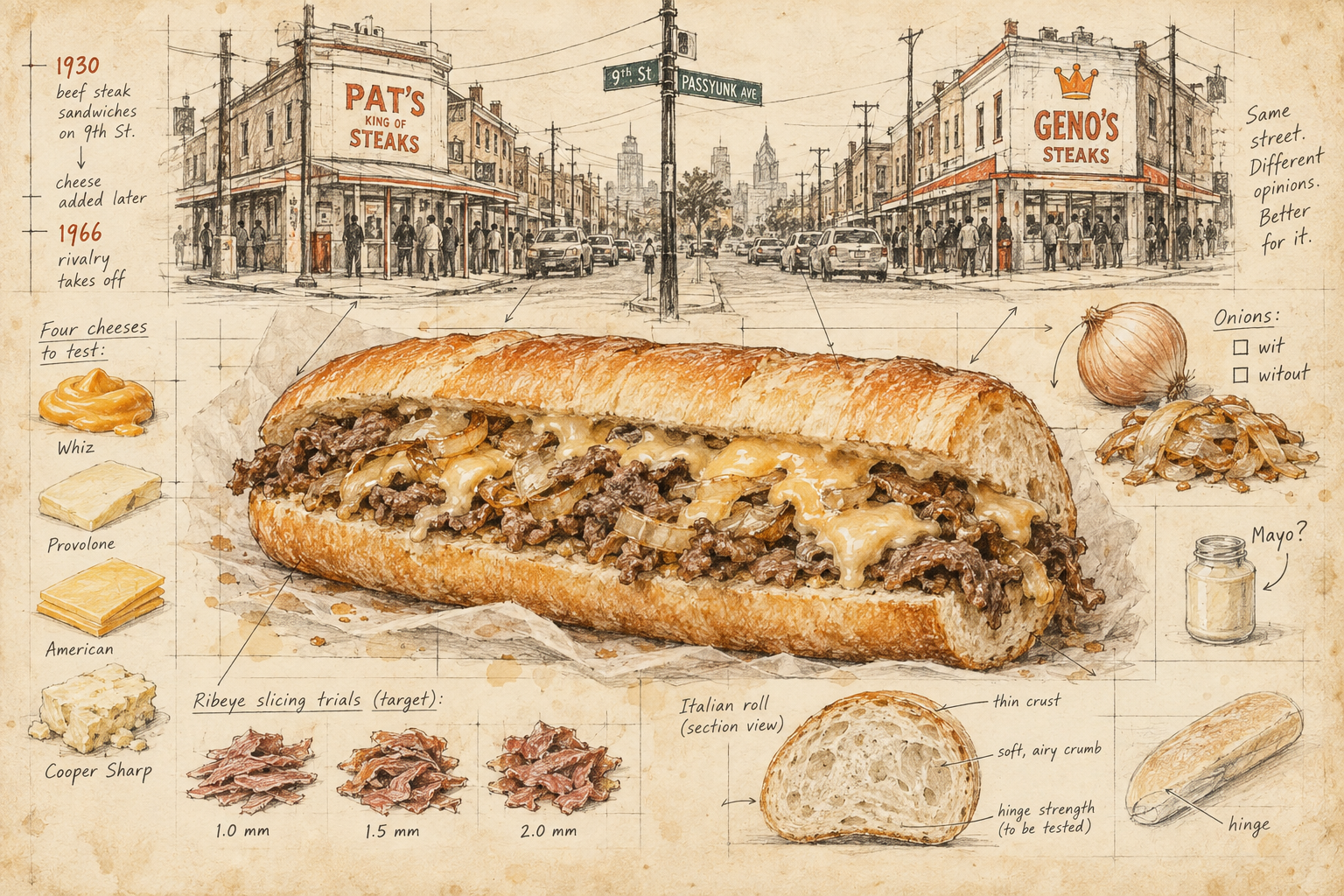
Pat eventually opened Pat's King of Steaks at 9th Street and Passyunk Avenue, where it remains today. Interestingly, the original sandwich wasn't actually a cheesesteak. It was a steak sandwich. Cheese came later. Pat's own history acknowledges that cheese was added as the sandwich evolved, while Philadelphia food history commonly credits a Pat's manager named Joe "Cocky Joe" Lorenza with adding provolone sometime in the 1940s.
Cheez Whiz couldn't have been part of the original sandwich because it didn't exist until the 1950s. It eventually became one of the cheeses most closely associated with the Philadelphia cheesesteak, alongside provolone and American.
And then, in 1966, things got interesting.
Pat's vs. Geno's
Directly across the intersection from Pat's sits one of the most recognizable restaurant rivalries in America.
Geno's Steaks was founded by Joey Vento in 1966. According to Geno's history, Vento started with two boxes of steaks, a few hot dogs and six dollars in his pocket.
People in the neighborhood reportedly predicted he wouldn't last six months.
He lasted a little longer than that.
Geno's and Pat's have now been staring at each other across 9th and Passyunk for decades, both serving cheesesteaks late into the night and giving generations of Philadelphians and tourists something to argue about.
There has even been disagreement over the cheese itself. Pat's history says cheese was added as its steak sandwich evolved, while Joey Vento claimed a role in making cheese part of the sandwich's identity. The better-supported historical account, however, puts provolone on Pat's steak sandwiches well before Geno's opened in 1966.
Today the ritual is almost as famous as the sandwich.
You choose your cheese and whether you want onions.
"Whiz wit."
Cheez Whiz. With onions.
"Provy witout."
Provolone. No onions.
That's about as complicated as this needs to be.
Which brings us to the important question.
What Actually Makes a Great Cheesesteak?
The more I researched this, the more I realized that the cheesesteak is remarkably similar to the Reuben in one important respect:
There is nowhere for bad ingredients or bad technique to hide.
Philadelphia's tourism authority describes the fundamental sandwich as a long, crusty roll filled with thinly sliced, freshly cooked ribeye and melted cheese. Cheez Whiz, American and provolone are all accepted cheese choices. Fried onions are traditional but optional.
That's basically it.
Beef.
Bread.
Cheese.
Maybe onions.
Four ingredients.
Which means all four had better be right.
The Beef
We're starting with ribeye.
Not sirloin.
Not shaved mystery beef from a frozen box.
Ribeye.
There's a reason it works. Ribeye has enough intramuscular fat to stay juicy during an extremely fast cook on a screaming-hot griddle. Geno's specifically identifies thinly sliced ribeye as its steak of choice, and Philadelphia's own descriptions of the classic sandwich repeatedly specify ribeye.
The next question is thickness.
We need this meat very thin.
My starting method will be to partially freeze whole boneless ribeye until it is firm enough to run through a commercial slicer cleanly. I'm going to begin around 1.5 millimeters and test thinner and thicker cuts from there.
And I'm starting with a 10-ounce raw portion.
That's intentionally generous. This is G&C Sandwich Company. If we're putting a cheesesteak on the menu, I want someone picking it up to know that we didn't get nervous when we reached for the beef.
But there is an important distinction between generous and ridiculous.
The sandwich still has to eat properly.
So 8, 10 and possibly 12 ounces will eventually get tested. My suspicion is that 10 ounces will be the sweet spot.
We'll see.
The Roll May Be the Hardest Part
I suspect the beef isn't going to be the most difficult ingredient to reproduce.
The bread will be.
A proper cheesesteak roll has to perform a strange balancing act.
It needs enough exterior structure that you can pick up a sandwich loaded with hot beef, cheese, onions and juices without the whole thing collapsing.
But it can't be a hard, chewy baguette.
The interior needs to be soft enough to compress around the filling and absorb some of the beef juices without immediately turning into paste.
Philadelphia descriptions frequently characterize the ideal cheesesteak roll as simultaneously soft and somewhat crusty.
That's exactly what we're looking for.
For the first tests, I want a 10- to 12-inch Italian-style roll with a thin crust, soft crumb and enough hinge strength to survive the sandwich.
I'm going to test commercially available Philadelphia-style rolls against locally sourced and bakery-made versions.
And I'm not automatically assuming the authentic Philadelphia roll will win.
The objective isn't to ship a piece of Philadelphia to Wisconsin and call the project finished.
The objective is to understand why that bread works and find the best way to reproduce those characteristics consistently in Oconomowoc.
And Then There's the Cheese
This is where we're going to have some fun.
Three cheese styles are firmly established in Philadelphia:
Cheez Whiz.
American.
Provolone.
And Pat's current menu even includes Cooper Sharp among its cheese options.
So I'm not choosing one yet.
We're testing them.
Test A: Whiz Wit
Cheez Whiz with grilled onions.
This is probably the cheesesteak most people outside Philadelphia picture when they hear "Philly cheesesteak."
There's something undeniably great about Whiz on this sandwich. It's salty, creamy, slightly tangy and melts into every crevice between the pieces of beef.
Is it sophisticated?
No.
Do I care?
Also no.
If it tastes great, it tastes great.
Test B: Provolone Wit
Provolone and onions.
This gets us closer to the sandwich's earlier Italian-American roots.
I'm particularly interested in testing mild versus sharper provolone. Too mild and it may disappear behind ten ounces of ribeye. Too sharp and suddenly we're eating a cheese sandwich with some steak underneath it.
There is a balance somewhere.
Test C: American — or Cooper Sharp — Wit
This might be the sleeper.
American-style cheese gives us the melting characteristics that make Whiz so effective, but with more structure and less sauce.
And Cooper Sharp is especially interesting because it gives us that beautiful processed-cheese melt while bringing substantially more cheese flavor.
I have a feeling this test is going to be important.
The Onions
We're keeping these simple.
Thinly sliced yellow onions cooked on the griddle until soft, lightly browned and sweet — but not caramelized into onion jam.
I still want them to taste like onions.
That's an important distinction.
They should complement the ribeye rather than turn the sandwich sweet.
And they'll be optional.
Because if we're going to do this properly, you should be able to order yours "wit" or "witout."
What We're NOT Putting on It
This may be equally important.
No green peppers.
No mushrooms.
No lettuce.
No tomatoes.
No mayo. Wait. I happen to be fan of mayo on my Philly. It's against tradition, but maybe there are others in Oconomowoc like me. It'll have to be an option.
No garlic aioli.
No steak sauce.
No elaborate spice rub.
At least not on the sandwich we're developing as the Original Philly Cheesesteak.
Can those ingredients make a good sandwich?
Absolutely.
But that's a different sandwich.
First I want to prove that we can make four ingredients taste extraordinary.
Test Kitchen: Round One
Here's the starting formula.
G&C Test Philly Cheesesteak
For one sandwich:
10 oz boneless ribeye, partially frozen and sliced approximately 1.5 mm thick
1 substantial 10–12" Italian-style cheesesteak roll
Approximately 3 oz thinly sliced yellow onion
3–4 oz cheese, depending on cheese being tested
Kosher salt
Freshly ground black pepper
Neutral high-heat oil, only if necessary for the griddle
That's it.
Even the black pepper is going to be tested.
I want to know whether seasoning the meat with salt and pepper improves the sandwich or whether salt alone lets the ribeye, onions and cheese do the talking.
The Cooking Method
This part matters enormously.
The flat-top needs to be hot.
I'm starting around 400–425°F.
The onions will hit the griddle first and cook until tender with some light browning. They'll move to a cooler section while the steak cooks.
Then the ribeye goes down in a relatively thin layer.
I don't want to immediately start hacking at it with spatulas.
Give the beef a few moments of uninterrupted contact with the griddle.
Then flip, chop and fold.
The objective is small, tender pieces of ribeye with a little browning — not ground beef.
Once the steak is nearly cooked, the onions come back.
Then comes another variable worth testing.
Do we place the cheese over the beef and let it melt?
Do we put the cheese into the roll?
Or, particularly with American or Cooper Sharp, do we incorporate the cheese into the steak as we fold it?
Whiz creates its own fourth option: assemble the steak and onions and ladle the molten cheese over everything.
These sound like tiny differences.
They aren't.
The distribution of cheese changes almost every bite.
The Test Matrix
Rather than changing everything simultaneously, we'll run this in stages.
Round One: Beef thickness
Same bread. Same cheese. Same onions.
We'll test approximately:
1.0 mm
1.5 mm
2.0 mm
I'm looking for tenderness, browning, juiciness and texture.
Once we find the beef cut, it stays fixed.
Round Two: Cheese
Then we'll test:
Cheez Whiz
Provolone
American
Cooper Sharp
Same steak. Same onions. Same bread. Same portion.
One variable.
Four sandwiches.
This is going to be a terrible day at the office.
Round Three: Bread
Once the filling is established, we'll test rolls.
I'll be looking at crust, interior softness, beef-juice absorption, structural integrity and — something people don't talk about enough — the bread-to-meat ratio in each bite.
A cheesesteak shouldn't feel like eating steak with bread attached.
And it shouldn't feel like eating a loaf of bread while desperately searching for the steak.
Round Four: Onion
We'll test onion thickness and cook level.
Lightly softened?
Lightly browned?
Deeply browned?
My prediction is somewhere between the first two.
Round Five: Portion
Finally:
8 ounces.
10 ounces.
12 ounces.
Not because bigger automatically means better.
It doesn't.
We're looking for the point where adding more meat stops improving the sandwich.
Then We Put It All Together
Once those variables are settled, there's one final test that matters more than any of them individually.
Can the person working the flat-top make ten of them exactly the same way?
Because making one incredible cheesesteak in my kitchen is interesting.
Making an incredible cheesesteak hundreds of times a week is a restaurant.
That means we'll eventually need exact specifications for the ribeye thickness, raw portion weight, onion weight, cheese weight, griddle temperature, cook time and roll.
We'll also need to see how well the process works when there are six orders on the rail instead of one.
That's when a recipe becomes an operation.
The Goal
I'm not trying to beat Philadelphia at its own sandwich.
And I'm certainly not going to settle the Pat's-versus-Geno's argument from a test kitchen in Wisconsin.
What I want to do is understand why this remarkably simple sandwich has survived for nearly a century.
My suspicion is that the answer is precisely because it is so simple.
Great ribeye.
Great bread.
Melted cheese.
Onions.
Heat.
Technique.
That's it.
And when we finally put the G&C version on the menu, I want someone from Philadelphia to be able to pick it up, look at it and immediately recognize what we're trying to do.
Then I want someone from Oconomowoc to take a bite and understand why Philadelphia has spent the better part of a century arguing about this sandwich.
Now we just have to figure out whether we're going Whiz wit, provy wit, or Cooper Sharp wit.
I suppose there's only one responsible way to find out.
We're going to have to eat a lot of cheesesteaks.
Tell us what you think.
The conversation links are coming soon.