
I've spent an absurd amount of time thinking about sandwiches.
Now I'm spending an absurd amount of time thinking about words describing sandwiches.
Welcome to restaurant development.
As I've gotten deeper into designing the menu for G&C Sandwich Company, I've realized that developing the food is only part of the job. Eventually, I have to hand someone a menu and convince them—using maybe 50 words—that the sandwich I've spent months developing is the sandwich they want for lunch.
That's menu writing.
And apparently there's considerably more to it than:
Reuben — corned beef, Swiss, sauerkraut, Thousand Island, rye.
Technically accurate.
Also incredibly boring.
On the other hand, I don't want this:
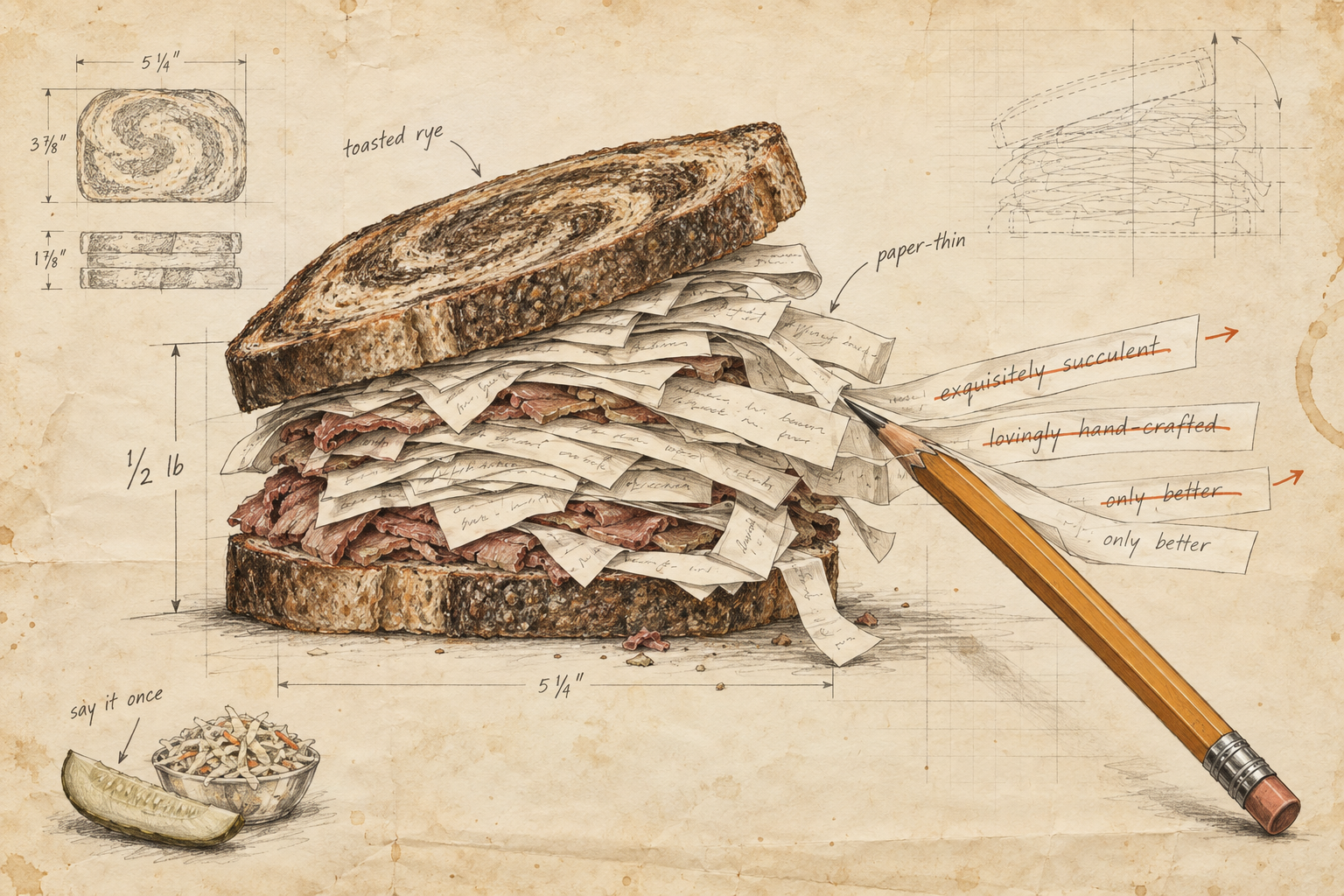
Our exquisitely succulent, lovingly hand-crafted, impossibly tender corned beef is delicately nestled between gloriously buttery slices of artisanal marble rye…
Good Lord.
It's a sandwich.
Somewhere between those two extremes is where I think G&C needs to live.
What Is a Menu Description Supposed to Do?
The first thing I'm trying to remember is that a menu isn't a cookbook.
Customers don't need every ingredient, every technique or the entire origin story of a sandwich. They need enough information to understand what they're ordering, enough sensory information to imagine eating it and enough personality to understand why our version is special.
For G&C, I've settled on a few principles.
Lead with substance. Tell people what they're actually getting.
Use specific words instead of generic adjectives. "½-pound of slow-roasted pork" tells you far more than "delicious premium pork."
Mention techniques when they matter. Slow-roasted, paper-thin sliced, toasted and house-made tell the customer something meaningful about the food.
Identify ingredients that differentiate us. Five-year aged cheddar matters. House-made basil mayonnaise matters. Pickled red onions matter. "Cheese" and "mayo" don't communicate the same thing.
Use sensory language, but don't abuse it. Golden, crisp, buttery, tangy, rich and tender help you imagine eating something. Seven adjectives describing the same piece of beef do not.
Give the restaurant a voice. G&C isn't supposed to sound like a corporate chain. "Kick you in the head" pickle and "double the meat if you dare" tell you something about us.
Know when to stop.
That last one may be where I still need some work.
So I decided to take the five sandwiches that are essentially finished and critique their descriptions as seriously as I've critiqued the food.
The G&C Classic Pulled Pork Sandwich
Here's where it stands:
The G&C Classic Pulled Pork Sandwich
A generous ½-pound of slow-roasted pork, hand-pulled while still warm and piled high on a toasted oversized brioche bun. Finished with its own rich roasting jus or our family-recipe BBQ sauce, then topped with house-made pickled red onions. Served with southern-style coleslaw and our crisp "kick you in the head" dill pickle spear. Slow-roasted, generously piled and proof that sometimes the simplest sandwiches are the hardest to beat.
Double the meat if you dare.
There's a lot I like here.
"½-pound" immediately communicates value and portion. "Slow-roasted" communicates technique. "Hand-pulled while still warm" gives the sandwich a handcrafted quality without actually saying handcrafted. And "toasted oversized brioche bun" gives you a pretty good mental picture of what's coming.
The choice between its own roasting jus and our family-recipe BBQ sauce is particularly important. The family sauce has history behind it, so calling it merely "BBQ sauce" would throw away one of the things that makes the sandwich uniquely ours.
"House-made pickled red onions" does the same thing.
Then we get to the final sentence.
"Slow-roasted, generously piled and proof that sometimes the simplest sandwiches are the hardest to beat."
I like the sentiment. But there's a problem.
We've already told the customer it's slow-roasted. We've already told them it's a generous half-pound and piled high.
I'm using precious menu space to say the same thing twice.
That's exactly the kind of thing I need to start catching.
I'd tighten the ending to:
Proof that sometimes the simplest sandwiches are the hardest to beat.
Same personality. No repetition.
And then there's:
Double the meat if you dare.
I'm keeping that.
It's playful, memorable and completely consistent with a restaurant selling half-pound sandwiches.
Although doubling this particular sandwich would mean a full pound of pulled pork.
So maybe the if you dare isn't entirely a joke.
The Cheesehead Grilled Cheese Melt
This one presents a different challenge:
Thick-cut ¾-inch brioche, grilled golden and crisp with four slices of melty American cheese and two slices of rich, 5-year aged cheddar. Add sweet caramelized onions or house-made pickled red onions to make it your own. Served with southern-style coleslaw and our crisp "kick you in the head" dill pickle spear. A childhood classic, all grown up—and unapologetically Wisconsin.
Add pulled pork, bacon, or slow-roasted brisket.
This description does something I really like.
It doesn't apologize for American cheese.
There are four slices of it.
American cheese melts beautifully. That's why it's there. But then we balance it with two slices of five-year aged cheddar, which brings sharpness, depth and unmistakable Wisconsin character.
That's the story of the sandwich, and the description communicates it without needing to explain it.
The numbers help here too.
Four slices of American.
Two slices of five-year cheddar.
Three-quarter-inch brioche.
You can almost see this thing before it arrives.
The phrase "grilled golden and crisp" adds just enough sensory language, and the final line may be one of my favorites:
A childhood classic, all grown up—and unapologetically Wisconsin.
That isn't describing ingredients anymore.
It's positioning the sandwich.
That's an important distinction.
A good menu description tells you what's in the food. A good closing line can tell you what the food is about.
I also like the add-ons here because they turn one sandwich into several possibilities without cluttering the actual menu with a pulled-pork grilled cheese, bacon grilled cheese and brisket grilled cheese.
That's smart menu architecture as much as it is menu writing.
The Northwoods Reuben
Here's the current description:
A generous ½-pound of our house-seasoned corned beef, slow-roasted until tender, sliced paper thin and piled high on buttery toasted marble rye. Finished with melted Swiss, tangy sauerkraut and our house-made Thousand Island dressing. Everything a classic Reuben should be—only better. Served with southern-style coleslaw and our crisp "kick you in the head" dill pickle spear. Everything a classic Reuben should be—only better.
Oops.
Apparently this Reuben is so good I needed to tell you twice.
The duplicate sentence obviously goes.
But there's another issue.
Where should that sentence go?
I think the answer is last.
The description should build the sandwich first: corned beef, rye, Swiss, sauerkraut, dressing. Then mention the accompaniments. Then give the customer the little
G&C punctuation mark at the end:
Everything a classic Reuben should be—only better.
There's also some good descriptive discipline happening here.
"House-seasoned" says we're doing something ourselves.
"Slow-roasted until tender" communicates preparation and texture.
"Paper thin" communicates the style of the beef.
"Buttery toasted marble rye" gives you flavor, texture and appearance in four words.
"Melted Swiss" and "tangy sauerkraut" are useful sensory descriptions.
And "house-made Thousand Island" differentiates what we're doing from squirting bottled dressing onto a sandwich.
This is exactly the kind of description I want: nearly every adjective earns its place.
The Supper Club Monster BLT
The BLT has a completely different job.
Everyone knows what a BLT is.
So the description doesn't need to explain a BLT.
It needs to explain why someone should pay attention to ours.
Six strips of thick-cut applewood-smoked bacon piled between two slices of toasted oversized sourdough, topped with crisp iceberg lettuce, thick-sliced heirloom tomatoes and house-made basil mayonnaise. A true Wisconsin supper club classic—built bigger. Served with southern-style coleslaw and our crisp "kick you in the head" dill pickle spear. A Wisconsin supper club classic, built bigger.
I have another repetition problem.
Apparently I really like that line too.
The solution is simple: say it once.
But there's a bigger lesson here.
Look at the nouns.
Applewood-smoked bacon.
Oversized sourdough.
Iceberg lettuce.
Heirloom tomatoes.
Basil mayonnaise.
That's why specificity matters.
Compare that with:
"Bacon, lettuce and tomato with mayo on toast."
Both descriptions are technically accurate.
They aren't selling the same sandwich.
One question I'm still considering is whether "six strips" helps.
With the pulled pork and Reuben, "½-pound" communicates abundance. With the grilled cheese, the slice counts help explain the ridiculous amount and combination of cheese.
Six strips of bacon might accomplish the same thing.
But if the name already says Monster BLT, I have to decide whether counting bacon strips makes it sound impressive or strangely precise.
For now, I think it stays.
And again, the final sentence gives the sandwich identity:
A Wisconsin supper club classic, built bigger.
Short.
Clear.
That's the whole idea.
The Windy City Beef
Then there's this one:
House-seasoned roast beef, slow-roasted until perfectly tender, sliced paper thin and piled high on a hearty Italian roll with rich, savory house-made jus. Topped with your choice of our house-made sweet peppers or spicy giardiniera. Order it wet or go all-in and have the whole sandwich dipped. Served with southern-style coleslaw and our crisp "kick you in the head" dill pickle spear. A Chicago classic, done the G&C way.
This may be the strongest description of the five.
It tells you exactly what the sandwich is without becoming a recipe.
It communicates preparation: house-seasoned, slow-roasted, paper thin.
It communicates texture and abundance: tender and piled high.
It gives the customer choices: sweet peppers or spicy giardiniera.
And then it introduces a little Chicago Italian-beef language:
Order it wet or go all-in and have the whole sandwich dipped.
I love that.
Someone familiar with Italian beef immediately knows what we're talking about. Someone unfamiliar with it can pretty easily figure it out.
And "go all-in" adds a little personality without turning the menu into stand-up comedy.
Finally:
A Chicago classic, done the G&C way.
That's exactly what this restaurant is supposed to do.
We're not claiming to have invented Italian beef.
That would be ridiculous.
We're respecting a regional classic, figuring out what makes the great versions great and then obsessing over our own version of it.
The description tells that story in six words.
One Thing Is Starting to Bother Me
Analyzing all five together revealed something I wouldn't necessarily have noticed looking at them individually.
There's a lot of repetition across the menu.
"Generous."
"Piled high."
"Slow-roasted."
"House-made."
"Southern-style coleslaw."
"Kick you in the head" dill pickle spear.
Some repetition is unavoidable. If something is house-made, I want to say it's house-made. If our sandwiches are intentionally generous, that's part of the brand.
But if everything is piled high, nothing is piled high.
That's something I'll have to police as the menu grows.
There's also a larger question about the sides.
Right now I'm spending roughly the same sentence on every sandwich:
Served with southern-style coleslaw and our crisp "kick you in the head" dill pickle spear.
Do I really need to print that fifteen times?
Probably not.
If those accompaniments are standard, that information may belong once in a prominent place on the menu:
All G&C signature sandwiches are served with southern-style coleslaw and our crisp "kick you in the head" dill pickle spear.
Suddenly I've removed an entire sentence from every sandwich description.
That's valuable real estate.
More importantly, the sandwich description becomes about the sandwich.
Finding the G&C Voice
That's probably my biggest takeaway from this exercise.
There are really two things happening when I write these descriptions.
I'm describing food.
And I'm developing the voice of the restaurant.
I don't want G&C to sound pretentious.
I don't want artisanal this and curated that.
I also don't want sterile ingredient lists.
The restaurant I'm imagining is generous, confident, approachable, slightly irreverent and serious about the food without taking itself too seriously.
That's why phrases like these work for me:
Double the meat if you dare.
A childhood classic, all grown up—and unapologetically Wisconsin.
Everything a classic Reuben should be—only better.
A Wisconsin supper club classic, built bigger.
Go all-in and have the whole sandwich dipped.
A Chicago classic, done the G&C way.
Those aren't really food descriptions.
They're G&C talking.
And I think that's an important distinction.
The Formula I'm Starting to See
After looking at these together, I think I'm beginning to develop a G&C formula.
Start with the hero ingredient.
Tell the customer something meaningful about how we prepare it.
Describe the bread and defining toppings.
Call out genuinely meaningful things that are house-made.
Use sensory words where they actually help someone imagine the bite.
Explain choices or customization clearly.
Then stop describing the ingredients and finish with one short line of personality.
Not every sandwich needs exactly the same structure. In fact, I don't want them to. But they should all sound like they were written by the same restaurant.
And every word should earn its place.
So I'd Change Them
If I were locking these five descriptions today, here's where I think I'd land.
The G&C Classic Pulled Pork Sandwich
A generous ½-pound of slow-roasted pork, hand-pulled while still warm and piled high on a toasted oversized brioche bun. Finished with its own rich roasting jus or our family-recipe BBQ sauce, then topped with house-made pickled red onions. Proof that sometimes the simplest sandwiches are the hardest to beat.
Double the meat if you dare.
The Cheesehead Grilled Cheese Melt
Thick-cut ¾-inch brioche, grilled golden and crisp with four slices of melty American cheese and two slices of rich, 5-year aged cheddar. Add sweet caramelized onions or house-made pickled red onions to make it your own. A childhood classic, all grown up—and unapologetically Wisconsin.
Add pulled pork, bacon or slow-roasted brisket.
The Northwoods Reuben
A generous ½-pound of our house-seasoned corned beef, slow-roasted until tender, sliced paper thin and piled high on buttery toasted marble rye. Finished with melted Swiss, tangy sauerkraut and our house-made Thousand Island dressing. Everything a classic Reuben should be—only better.
Double the meat if you dare.
The Supper Club Monster BLT
Six strips of thick-cut applewood-smoked bacon piled between two slices of toasted oversized sourdough with crisp iceberg lettuce, thick-sliced heirloom tomatoes and house-made basil mayonnaise. A Wisconsin supper club classic, built bigger.
Double the bacon if you dare.
And yes, I changed that one.
"Double the meat" sounds like something you say about brisket or corned beef.
It's a BLT.
Double the bacon if you dare is better.
The Windy City Beef
House-seasoned roast beef, slow-roasted until tender, sliced paper thin and piled high on a hearty Italian roll with rich, savory house-made jus. Top it with our house-made sweet peppers or spicy giardiniera. Order it wet or go all-in and have the whole sandwich dipped. A Chicago classic, done the G&C way.
Double the meat if you dare.
Then, elsewhere on the menu:
All G&C signature sandwiches are served with southern-style coleslaw and our crisp "kick you in the head" dill pickle spear.
That's cleaner.
More importantly, it gives each sandwich room to tell its own story.
We're Not Selling Adjectives
I think that's ultimately the lesson.
Good menu writing isn't about making food sound fancy.
It's about making food sound specific.
There's a huge difference.
I don't need to tell you our sandwich is amazing, incredible, mouthwatering or delicious.
Those words are cheap.
Tell you it's a half-pound of corned beef.
Tell you we slice it paper thin.
Tell you the rye is buttery and toasted.
Tell you the cheddar has been aged five years.
Tell you we make the basil mayonnaise.
Tell you we'll dip the entire Italian beef in jus if that's how you want it.
Then let the customer decide whether that sounds delicious.
And when the sandwich finally hits the table?
The menu has made a promise.
Now the food has to keep it.
Tell us what you think.
Join the conversation on Facebook, X or Substack.