
If you grew up in Wisconsin, you don't need anyone to explain the tradition of the Friday fish fry.
It's just something we do.
Friday night rolls around and restaurants, taverns, supper clubs, church halls, VFW lodges, and neighborhood bars across the state start serving fish. Cod. Haddock. Perch. Walleye. Bluegill. Sometimes baked, but let's be serious—usually fried. Add some fries or potato pancakes, coleslaw, rye bread, tartar sauce, and maybe an Old Fashioned while you're waiting, and you've got one of the most recognizable food traditions in Wisconsin.
But like a lot of food traditions, there's a story behind this one.
Wisconsin's Friday fish fry can trace much of its history to the state's Catholic immigrants, particularly the German and Polish communities that arrived here in large numbers during the nineteenth century. Catholics traditionally abstained from eating meat on Fridays, which created an obvious question: What do you eat instead?
In Wisconsin, the answer wasn't particularly difficult.
Fish.
We had plenty of it.
Wisconsin's lakes and rivers provided perch, walleye, bluegill, and other freshwater fish that were plentiful and relatively inexpensive. The religious tradition and the abundance of local fish were a pretty natural combination.
Then came Prohibition.
With alcohol sales prohibited, Wisconsin taverns needed another reason to get people through the door. Inexpensive Friday fish dinners helped do exactly that. By the time the Catholic Church relaxed its year-round Friday abstinence requirements in the 1960s, Wisconsin didn't really need the religious requirement anymore.
We had created a tradition.
Friday night meant fish.
And generations later, it still does.
So when I started thinking about what Fridays should look like at G&C Sandwich Company, putting fish on the menu seemed almost inevitable.
But there was a problem.
Oconomowoc doesn't exactly suffer from a shortage of Wisconsin fish fries.
There are restaurants all around us that have been doing them for years, and some of them do them very well. I have no interest in making another plate of fried fish, coleslaw, rye bread, and potato pancakes simply because that's what a Wisconsin restaurant is supposed to serve on Friday.
If we're going to do this, I want there to be a reason to come to G&C for it.
And strangely enough, I found the answer about 3,700 miles away.
We're going to Britain.
Proper Fish & Chips
Fish and chips may look familiar to anyone who loves a Wisconsin fish fry, but it's its own thing.
The dish emerged in Britain in the nineteenth century and eventually became one of the country's defining foods. There is even some disagreement over whether the first true fish-and-chip shop originated in London or Lancashire—which seems appropriate for a food people feel this strongly about.
The basic formula couldn't be much simpler.
Fish.
Chips.
Salt.
Vinegar.
Simple, however, rarely means easy.
The fish is traditionally a mild, flaky white fish, most commonly cod or haddock, surrounded by a light batter and fried until beautifully golden and crisp. The chips aren't American French fries. They're thicker and more substantial, with a lightly crisp exterior surrounding a soft, fluffy potato center.
Then there is malt vinegar.
And tartare sauce.
A wedge of lemon.
And, of course, mushy peas.
Proper mushy peas.
We'll get to those.
But first, the fish.
Twelve Ounces of Cod
I went back and forth on the size.
Seven or eight ounces would certainly make a respectable piece of fish. Ten ounces would make a pretty generous one.
But this is G&C.
We're going with twelve ounces.
Not three little pieces of cod arranged next to a pile of fries. Not a couple of rectangular frozen portions that look exactly like the fish you can get at a hundred other restaurants.
I want one enormous, beautiful, natural-cut fillet of cod.
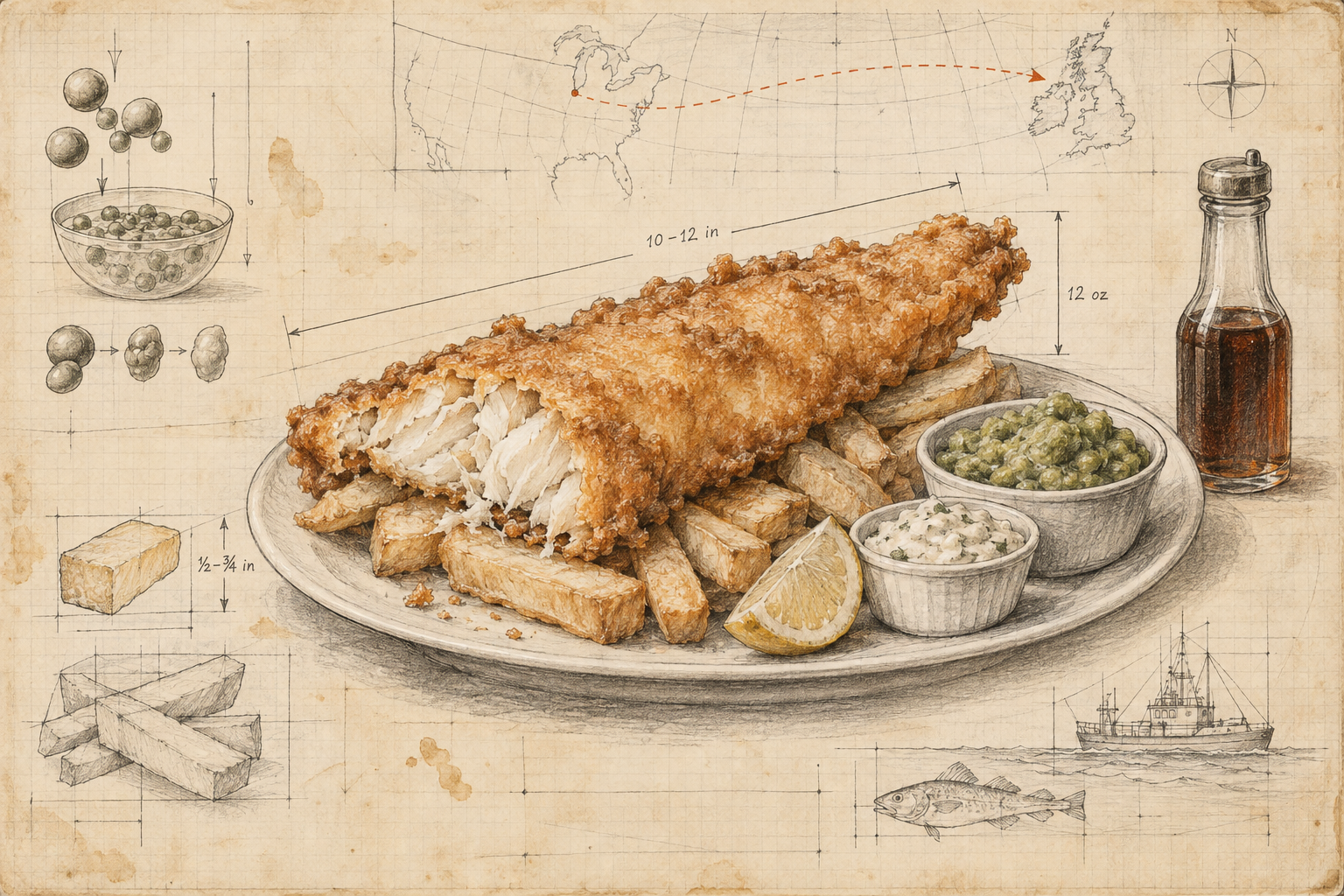
The target is roughly 10 to 12 inches long and four to five inches wide before it ever touches the batter.
Three-quarters of a pound of fish.
One piece.
A showpiece.
The plan is to use skinless, boneless Atlantic cod with enough thickness to give us those big, beautiful flakes of moist fish when you break through the batter, but not a thick, squat cod loin. I want the longer natural shape of the fillet—the kind of piece of fish that looks almost ridiculously large when it arrives at the table.
Almost.
Once it's dipped in batter and fried, we're potentially talking about a piece of golden battered cod approaching a foot long.
That's more like it.
Of course, size means absolutely nothing if the fish isn't properly cooked.
The batter needs to be incredibly crisp without being thick or doughy. The fish underneath needs to remain moist, tender, and flaky. When you cut into it, I want to hear the batter crack and see steam escape from the cod underneath.
That means there is going to be some testing.
Beer batter?
Beer and ale?
Soda water?
Flour and cornflour?
Different frying temperatures?
Beef dripping?
There are apparently quite a few ways to make "proper" British battered fish, which means I'm going to have to eat a lot of fried cod in the name of research.
I'll manage.
And Then There Are the Chips
This may actually be harder.
One of the first things I've learned in researching proper British fish and chips is that calling the potatoes "fries" misses the point.
These need to be chips.
Thick ones.
A proper British chip isn't supposed to resemble an American fast-food French fry. It should have some substance to it—a lightly crisp, golden exterior with a fluffy, almost baked-potato-like center.
That means my previous G&C French fry experiments don't necessarily apply here.
We're starting over.
I'll be testing thick-cut russet potatoes, probably somewhere around a half-inch to three-quarters of an inch, along with different combinations of parboiling, blanching, cooling, and final frying.
And here's something that goes against almost everything I've been trying to accomplish with our regular fries:
I don't necessarily want these too crispy.
They need enough exterior structure to hold up underneath that giant piece of cod—and enough to survive a healthy splash of malt vinegar—but the interior needs to remain soft and fluffy.
There will be malt vinegar on the table.
Lots of it.
About Those Mushy Peas
This one isn't negotiable.
If we're doing proper British fish and chips, we're serving mushy peas.
And no, apparently that doesn't mean throwing frozen peas into a food processor.
Traditional mushy peas begin with dried marrowfat peas. They're soaked—often overnight with a little bicarbonate of soda—and then slowly cooked until the peas soften and naturally begin to collapse.
The result isn't supposed to be a silky green puree.
It's rustic. Thick. Soft. A little lumpy.
In other words, mushy.
I haven't decided exactly how we'll finish ours yet. Butter seems likely. Maybe a little malt vinegar. Mint appears in some versions, although I'm not convinced I want it in ours.
That's what the test kitchen is for.
So What Exactly Are We Making?
At this point, I think I know what the plate looks like.
A 12-ounce natural-cut Atlantic cod fillet, battered to order and fried until golden and shatteringly crisp.
A generous pile of thick-cut, properly cooked chips.
House-made tartare sauce.
A wedge of lemon.
A generous scoop of real marrowfat mushy peas.
And malt vinegar.
That's it.
No coleslaw.
No rye bread.
No potato pancakes.
Those things belong to the Wisconsin fish fry, and I don't want to pretend we're improving upon a tradition Wisconsin has spent generations perfecting.
We're doing something different.
There is something I really like about that.
Friday fish at G&C will still be rooted in Wisconsin tradition. After all, the reason we're putting fish on the menu every Friday in the first place is because we're opening a restaurant in Wisconsin, and Friday night means fish here.
But instead of trying to recreate the same fish fry you can find at supper clubs and taverns all over the state, we're going to borrow from another place that takes its fried fish every bit as seriously as Wisconsin does.
On Fridays, we're going across the pond.
Twelve ounces of cod. Proper chips. Mushy peas. Malt vinegar.
Now I just have to figure out how to make every single part of it perfect.
Tell us what you think.
Join the conversation on Facebook, X or Substack.