
I've spent a lot of time developing sandwiches.
A lot of time.
I've roasted briskets, cooked corned beef, pulled pork shoulders, fried chicken, made pickles, experimented with coleslaw, tested mayonnaise, sliced beef paper-thin, made cheese sauces, screwed up french fries, fixed french fries, and eaten more test sandwiches than is probably medically advisable.
And somewhere along the way, something interesting happened.
I started to have a menu.
Or at least I thought I did.
It turns out that having a collection of dishes you want to serve and designing a restaurant menu are two very different things.
That's one of the lessons that became much clearer to me in culinary school. A menu isn't simply an inventory of everything a restaurant knows how to make. It's one of the clearest expressions of the restaurant's concept.
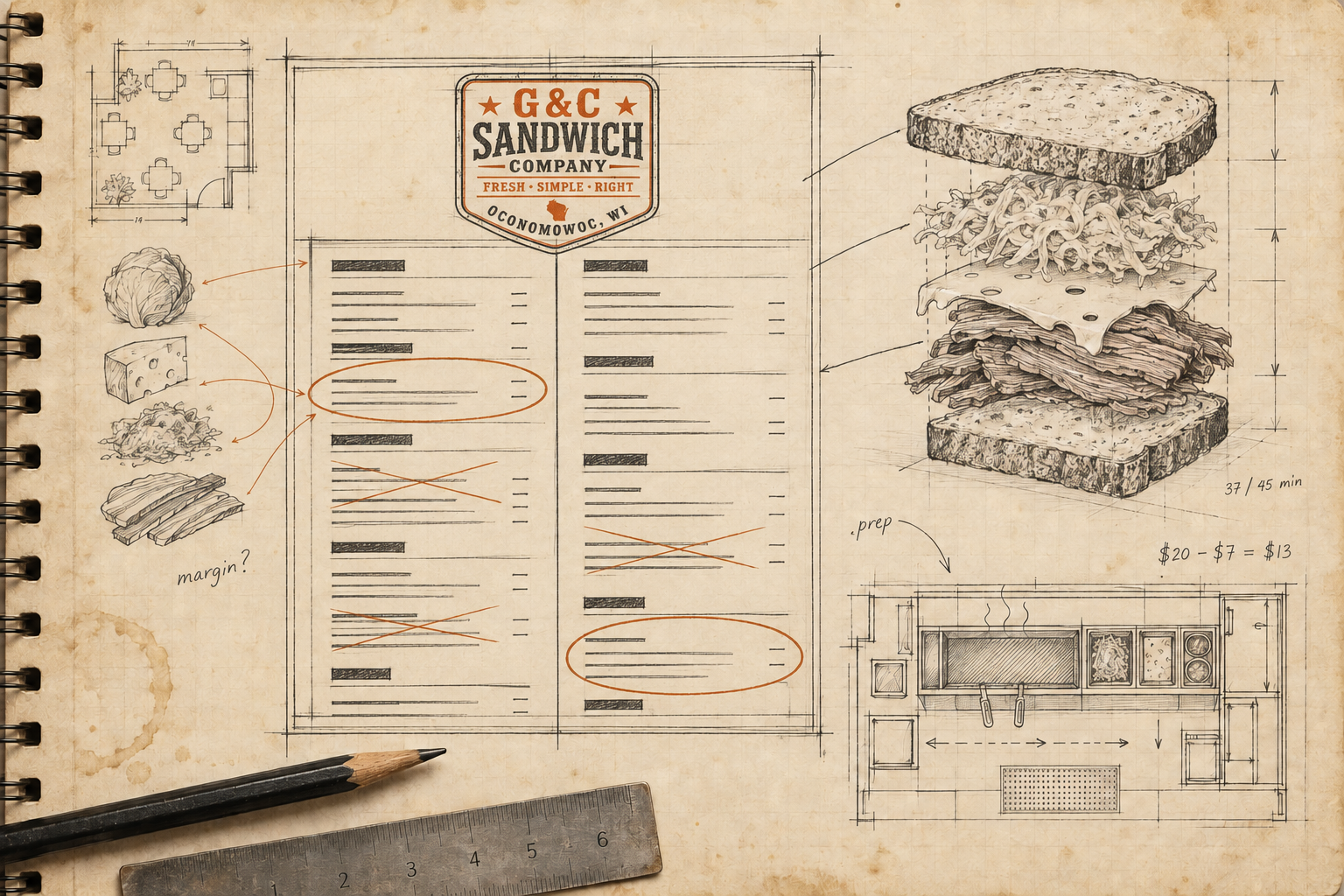
And now I have to design one for G&C Sandwich Company.
Start With the Concept
This sounds obvious, but it's surprisingly easy to get backward.
You shouldn't develop 40 things you love to cook and then invent a restaurant capable of selling all of them.
The concept comes first.
One of the definitions we worked with in culinary school described a restaurant concept in terms of three basic questions: What are you selling? Who are you selling it to? And what kind of service are you providing?
That's remarkably useful.
For G&C Sandwich Company, I'm getting closer to the answer.
This isn't going to be a deli.
It isn't fast food.
It isn't a generic burger-and-sandwich restaurant.
And I'm not particularly interested in inventing bizarre sandwiches simply for the sake of being different.
The idea is much simpler.
I want to take great American sandwiches—the kinds of sandwiches I've eaten around the country and loved for decades—and make really, really good versions of them.
A great Philly cheesesteak.
A proper Chicago Italian beef.
A monster BLT.
A fantastic Reuben.
Pulled pork.
Crispy chicken.
Grilled cheese.
Maybe a schnitzel sandwich.
A couple of great hot dogs.
And on Fridays in Wisconsin, a giant piece of proper fish and chips.
My culinary school training makes another point I think is particularly important: the concept needs to respond to the community. What does the community want? What can customers afford? What kind of experience fits the location?
Those questions matter in Oconomowoc.
I don't want to build a menu in a vacuum based entirely on what I want to eat. I need to build a menu that makes sense for the people who will actually walk through the door.
The Hardest Part May Be Saying No
Here's my problem.
I love sandwiches.
That's convenient when you're opening a sandwich restaurant, but it can also be dangerous.
Every time I research another regional sandwich, I find something else I want to put on the menu.
A Cuban would be great.
What about a muffuletta?
A French dip?
A turkey club?
A meatball sandwich?
A pork tenderloin?
Maybe a lobster roll?
Stop.
At some point, a restaurant that serves everything stops standing for anything.
One of the ideas emphasized in my coursework was the importance of narrowing the concept so the menu remains clean and concise. That may be one of the most important rules I have to impose on myself.
Every sandwich can't make the team.
So I need a test.
For every item I'm considering, I think I'm going to ask essentially the same questions:
Does this belong at G&C Sandwich Company?
Is it meaningfully different from something already on the menu?
Will people in our market actually order it?
Can we make an exceptional version of it?
Can we execute it consistently during a busy lunch rush?
Does it use ingredients that appear elsewhere on the menu?
Can we sell it at a price customers will accept?
Does it generate enough contribution margin to justify its existence?
And perhaps most importantly: would I be disappointed if someone visited G&C for the first time and this was the sandwich they ordered?
That last one may be my favorite test.
If I'm not proud enough of something to have it represent the restaurant, why is it on the menu?
The Menu Has to Work in the Kitchen
This is where my engineering brain starts fighting with my cook brain.
The cook says:
"That would be delicious."
The engineer says:
"How exactly are we going to make 37 of those between 11:45 and 12:30?"
The engineer has a point.
I've been developing these recipes one at a time in my home kitchen. That's useful for figuring out whether something tastes good. It tells me almost nothing about whether a restaurant can execute it efficiently.
Suppose one sandwich needs six ingredients that appear nowhere else on the menu, requires its own sauce, uses a unique bread, occupies a burner for eight minutes and takes four minutes to assemble.
It might be fantastic.
It might also be a terrible restaurant menu item.
That means the menu and the kitchen have to be designed together.
I need to think about equipment capacity. Refrigerated storage. Prep time. Holding. Fryer capacity. Griddle space. Oven space. Assembly stations. Bread storage. Ingredient shelf life. Cross-utilization. Ticket times.
And labor.
Especially labor.
If five sandwiches arrive simultaneously, can the line actually produce them?
That's a very different question from whether I can make one beautifully on a Saturday afternoon at home.
Ingredient Cross-Utilization Matters
There's another balancing act here.
I don't want G&C to taste like every sandwich is assembled from the same twelve ingredients.
But I also can't stock an entirely separate pantry for every item.
That's where smart menu development becomes almost a puzzle.
Pickled red onions already work on several sandwiches.
Great.
The house dill pickle isn't merely a garnish; it's part of the identity of the restaurant.
Even better.
The same crispy chicken preparation can potentially support the Wisconsin Avenue Crispy Chicken and the Buffalo Bleu without requiring two completely different production systems.
That's efficient.
But if I introduce an ingredient for exactly one sandwich, I need a good reason.
Every unique SKU takes refrigerator or dry-storage space. It has to be ordered, received, stored, rotated and inventoried. It can spoil. Someone has to prep
it. Eventually somebody throws some of it away.
Multiply that by an unnecessarily complicated menu and you've created an operational problem before the first customer arrives.
Then There Is Price
This is where menu development gets uncomfortable.
I can make an incredible sandwich.
That doesn't mean anyone will pay what I need to charge for it.
I've already run into this with the G&C sandwiches because I like generous portions. A half-pound of meat sounds fantastic when you're designing a sandwich.
Then you cost eight ounces of brisket.
Suddenly you're having a very different conversation.
Every item ultimately has to work mathematically.
I need a standardized recipe. I need an actual yield. I need an actual portion cost—not what I think the ingredient costs before trimming and cooking. Then
I need to account for the bread, cheese, sauces, vegetables, sides and everything else that ends up on the plate.
Only then can I begin talking intelligently about price.
And food-cost percentage isn't the only number that matters.
Contribution margin matters too.
A $15 sandwich at a 25% food cost produces $11.25 before the other expenses of the restaurant.
A $20 sandwich at a 35% food cost produces $13.
The second sandwich has a worse food-cost percentage but puts more dollars toward labor, utilities, insurance and everything else required to keep the restaurant operating.
That's why I don't want to blindly design the menu around a single food-cost percentage.
The numbers need context.
I Also Need Price Architecture
I've been thinking about the G&C menu in rough pricing tiers.
That may change considerably before opening, but I like the concept.
There should be approachable choices. There should be substantial signature sandwiches. And there may be a few legitimate showpieces that cost more because they're expensive to produce.
The important thing is that the customer understands why.
If one sandwich costs $15 and another costs $20, the $20 sandwich had better look and eat like a $20 sandwich.
Value doesn't necessarily mean cheap.
Value means the guest believes what arrived in front of them was worth what they paid.
That's a standard I can live with.
Variety Without Chaos
A good sandwich menu also needs balance.
If I ended up with seven beef sandwiches because I happen to love beef, that's not really variety.
I need to look at the menu as a whole.
Beef.
Pork.
Chicken.
Fish.
Meatless.
Hot.
Cold.
Rich.
Fresh.
Fried.
Griddled.
Slow-roasted.
Familiar.
Adventurous.
Then there are soups, salads, hot dogs, fries, tots, desserts and beverages.
The challenge is providing enough choice that different customers can find something they want without handing them a small novel when they sit down.
I don't want people studying the G&C menu for 15 minutes.
I want them thinking:
"I want that."
Followed almost immediately by:
"Wait. I want that too."
That's probably the sweet spot.
The Menu Is Also a Salesperson
Only after all of those decisions do we get to what most people probably think of when they hear menu design.
The actual menu.
The layout matters because customers don't give every square inch of a menu equal attention.
Categories matter.
Item placement matters.
Names matter.
Descriptions matter.
Typography matters.
White space matters.
Photography—if we use any—matters.
Even the way prices are presented can change how a guest experiences the menu.
I don't want the G&C menu to feel like an Excel spreadsheet with food listed in the left column and prices in the right.
The menu needs hierarchy.
There should be a handful of sandwiches that unmistakably say this is G&C.
The G&C Classic Pulled Pork should feel important.
The Oconomowoc Brisket Stack should feel important.
The Northwoods Reuben should feel important.
The Supper Club Monster BLT should feel important.
And whatever ultimately becomes our defining crispy chicken sandwich should feel important.
That doesn't necessarily mean giant boxes, stars, photographs and arrows screaming BUY THIS ONE!
In fact, I suspect I'll want the opposite.
Clean.
Confident.
Easy to navigate.
A little personality.
Enough description to make you hungry without writing a paragraph beneath every sandwich.
The physical menu should look like it belongs in the same restaurant as the food.
That's another principle from culinary school that seems almost embarrassingly obvious once someone says it: the menu should reflect the restaurant's design.
If G&C is warm, comfortable, distinctly Wisconsin and slightly nostalgic without becoming kitschy, the menu should communicate exactly the same thing.
But the First Menu Won't Be the Final Menu
This may be the biggest thing I've learned.
Opening day doesn't finish menu development.
It starts the next experiment.
Once real customers start ordering, I'll finally have something I've never had during all these months of testing:
data.
What sells?
What doesn't?
What makes money?
What sells constantly but doesn't make enough money?
What makes great money but nobody orders?
What slows down the kitchen?
What generates waste?
What gets returned?
What do customers rave about?
What do they order again?
That's when menu analysis becomes enormously important.
Broadly speaking, I'll eventually be able to look at items through two lenses: popularity and profitability.
The dream item is obvious: customers love it and it makes money.
But there will almost certainly be popular dishes with disappointing margins. There may be profitable dishes that don't sell enough. And there will probably be something I personally adore that customers simply don't care about.
That's going to hurt.
But if nobody orders Doug's favorite sandwich, Doug's favorite sandwich probably shouldn't occupy permanent space on the menu.
Maybe it becomes a special.
Maybe I change it.
Maybe I improve the description or its placement.
Maybe I change the price.
Or maybe I kill it.
The menu has to be allowed to evolve.
So What's the Plan?
For G&C, I think the process now needs to become much more disciplined.
First, establish the opening-menu architecture. How many signature sandwiches? How many chicken sandwiches? How many hot dogs? How many salads? Which soups? Which sides? Which desserts? I want to decide how many slots exist before deciding everything that fills them.
Second, make every candidate earn its slot. Taste isn't enough anymore. Each item needs to pass the concept, customer, execution, ingredient, cost and profitability tests.
Third, standardize everything. Exact recipes. Exact yields. Exact portions. Exact plating. Exact food costs. If the portion is eight ounces of corned beef, it's eight ounces—not whatever someone grabs.
Fourth, simulate service. I don't just want to cook these sandwiches individually anymore. Eventually I need to generate mock tickets and find out what happens when someone orders a Reuben, cheesesteak, Buffalo Bleu, Italian beef and grilled cheese at the same time.
That should be interesting.
Fifth, build the price architecture. Not simply "food cost divided by 30%," but prices that make sense for the product, market, portion, competitive environment and contribution margin.
Sixth, design the actual menu. Categories, hierarchy, descriptions, typography, branding and visual emphasis should make ordering easy while gently directing attention toward the dishes that best represent G&C.
And finally, measure everything once we open. Sales mix, food cost, contribution margin, waste, ticket time and customer feedback should determine how Menu 2.0 evolves.
A Menu Is a Promise
I've spent months thinking that I'm developing recipes.
I am.
But I'm beginning to understand that I'm also doing something much bigger.
I'm deciding what G&C Sandwich Company is.
Every item I put on that menu becomes a promise.
If I call something the Northwoods Reuben, I'm promising you a great Reuben.
If I put a giant 12-ounce piece of fish on the Friday menu, I'm promising you it's worth ordering.
If I call something the G&C Classic, I'm effectively saying, This is us.
That's a pretty high bar.
And I like that.
The goal isn't to create the biggest sandwich menu in Wisconsin.
It isn't to have something for absolutely everyone.
And it definitely isn't to cram every sandwich I've ever loved onto one piece of paper.
The goal is to create a menu where everything belongs.
Where every sandwich has a reason for being there.
Where the kitchen can execute it.
Where the economics work.
Where the price makes sense to the customer.
And where someone can look at that menu before taking a single bite and already begin to understand exactly what G&C Sandwich Company is supposed to be.
Turns out designing a menu is a lot harder than making a sandwich.
Good.
That's what makes this fun.
Tell us what you think.
Join the conversation on Facebook, X or Substack.