
I love a good hot dog.
There. I said it.
We're building G&C Sandwich Company around some pretty serious sandwiches. Half-pound piles of corned beef. Slow-roasted pulled pork. Italian beef. Cheesesteaks. Giant BLTs. Crispy chicken. We're spending ridiculous amounts of time thinking about bread, meat, sauces, pickles, cooking temperatures and whether something as seemingly insignificant as the thickness of an onion slice can make a sandwich better.
So where does the humble hot dog fit into all of this?
Pretty easily, actually.
Because a great hot dog isn't really humble at all.
Like so many of the foods I've been researching for G&C, the hot dog is one of those wonderfully simple foods that Americans have spent more than a century turning into something intensely regional. Travel around the country and the basic formula stays the same—sausage, bun, toppings—but what happens after that can tell you exactly where you are.
Chicago has its dog.
New York has its dog.
Michigan has its Coney.
Arizona has the Sonoran dog. West Virginia adds chili and coleslaw. Washington, D.C., has the half-smoke. Seattle somehow decided cream cheese belonged on a hot dog—and people love it.
I don't think G&C Sandwich Company needs ten hot dogs.
I think we need three really good ones.
And I think I've figured out which three.
The Chicago Dog
This one was never really up for debate.
I've lived in Chicago long enough to know that if I'm going to put a Chicago-style hot dog on the menu, there isn't much room for interpretation.
You don't improve a Chicago dog.
You make a Chicago dog.
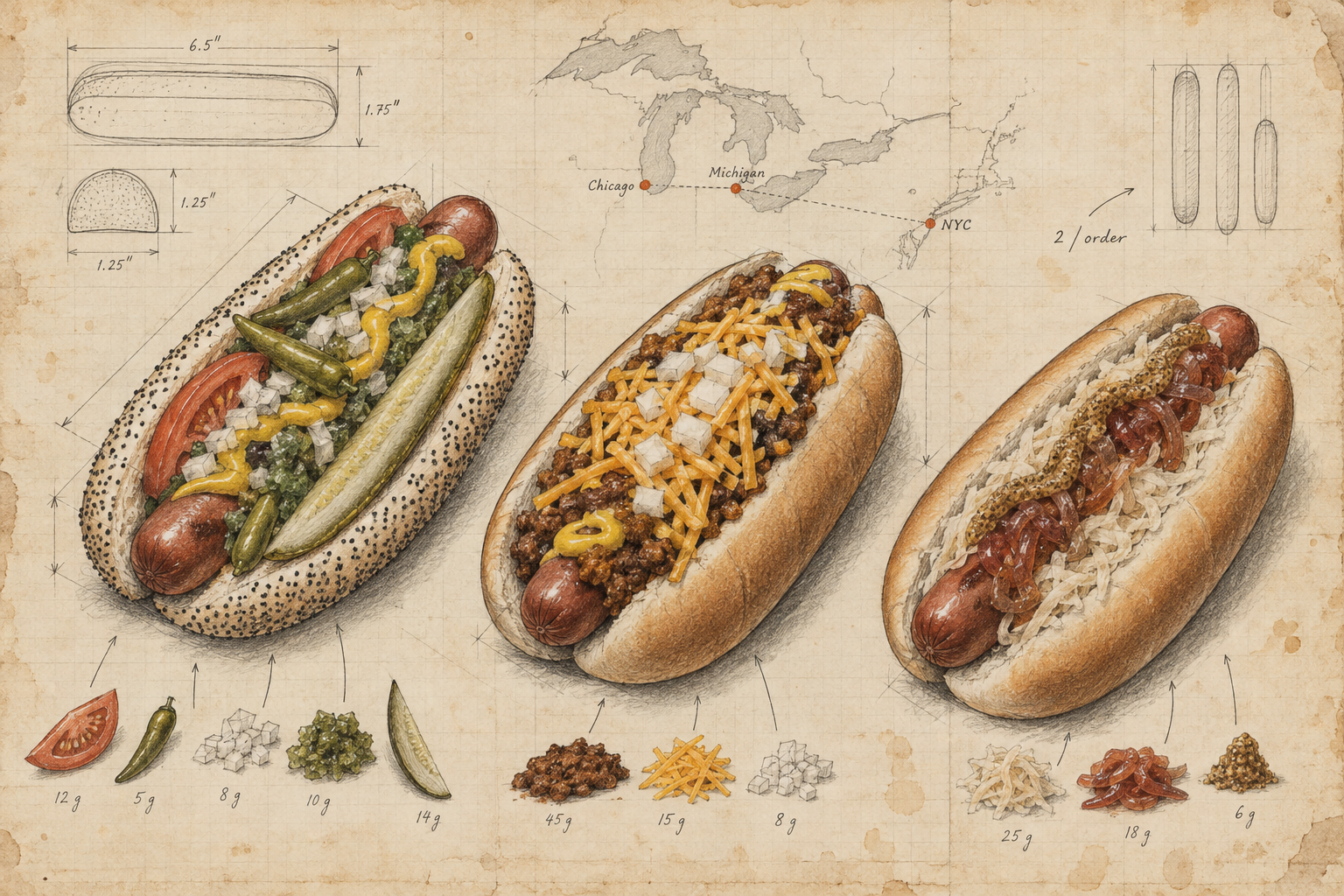
The classic starts with an all-beef frank on a steamed poppy-seed bun. Then it gets "dragged through the garden": yellow mustard, chopped white onion, that unmistakable bright-green sweet relish, tomato, a dill pickle spear, sport peppers and celery salt.
And no ketchup.
That's not me making up rules for the restaurant. That's Chicago.
The modern Chicago dog evolved from the inexpensive "Depression Dog" sold during the Great Depression, when vendors could turn a nickel hot dog into something approaching a meal by loading it with vegetables and condiments. Vienna Beef itself dates to 1893, when founders Emil Reichel and Samuel Ladany introduced their sausages at Chicago's World's Columbian Exposition.
More than a century later, the formula is remarkably specific.
For G&C, I want to respect that.
The G&C Chicago Dog
My starting point for testing will be:
Natural-casing all-beef frank
Steamed poppy-seed bun
Yellow mustard
Bright-green Chicago relish
Finely diced white onion
Fresh tomato wedges
Dill pickle spear
Sport peppers
Celery salt
That's it.
Vienna Beef will be the obvious benchmark for the frank. The natural casing is particularly interesting to me because of the "snap." That's one of those small details that can separate a good hot dog from one you remember.
And I already know something else.
I'm not making fluorescent-green relish from scratch just so I can say it's house-made.
Sometimes authenticity means making something yourself.
Sometimes authenticity means knowing when somebody else already makes exactly what the dish requires.
The Chicago dog will probably teach me quite a bit about that distinction.
The Chili Cheese Dog
This one sent me down a rabbit hole.
I originally wrote down:
Classic Chili Cheese Dog.
Simple enough.
Then I started asking a question that tends to make everything in the G&C test kitchen more complicated:
What exactly is a classic chili cheese dog?
And where is it from?
Turns out, that's not as straightforward as you might think.
There are chili dogs all over the United States, and several regions have legitimate claims to their own distinct versions. Cincinnati has its own tradition. West Virginia has chili dogs topped with slaw. Texas has plenty of chili-and-cheese dogs.
But one of America's strongest and oldest chili-dog traditions belongs to Michigan.
The Coney dog.
And despite the name, the Coney dog wasn't created on Coney Island.
Michigan's version was developed largely by Greek and Macedonian immigrants in the early twentieth century. Detroit's American Coney Island opened in 1917, with Lafayette Coney Island following nearby in 1924, while Jackson, Michigan, traces its Coney tradition even earlier.
A traditional Detroit-style Coney is beautifully simple:
Natural-casing beef frank
Steamed bun
Beanless meat chili
Yellow mustard
Diced white onion
Notice something missing?
Cheese.
So technically, if I want a classic chili cheese dog, I shouldn't call it a Detroit Coney.
That's actually useful.
I can borrow from the Michigan Coney tradition without pretending we're serving something we're not.
The G&C Chili Cheese Dog
I'm thinking:
Natural-casing all-beef frank
Soft steamed bun
House-made beanless beef chili
Sharp Wisconsin cheddar
Finely diced white onion
Yellow mustard
That sounds like G&C.
The big development project here isn't going to be the hot dog.
It's going to be the chili.
I don't want a bowl-of-chili recipe dumped onto a frank. Hot-dog chili is its own thing. It needs to be finely textured, relatively thick, beef-forward and capable of sitting on the dog instead of soaking through the bun and landing in your lap.
No giant chunks of tomato.
No kidney beans.
No big pieces of ground beef rolling off the thing.
I'm looking for something much closer to a traditional Coney sauce: finely textured beef, restrained tomato, onion and spices cooked until everything almost becomes one cohesive meat sauce.
Then Wisconsin gets involved.
Cheese.
And if we're putting cheese on something at G&C Sandwich Company, I'm not particularly interested in a sad sprinkle of pre-shredded cheese.
I want real Wisconsin cheddar with enough flavor to stand up to the chili.
How much?
No idea yet.
That's why there's a test kitchen.
The New York Street-Cart Dog
And then there's New York.
If Chicago's hot dog looks like somebody emptied the produce aisle onto a sausage, the New York street-cart dog is almost comically restrained.
And that's exactly why I love it.
Picture the cart.
Steam rolling out when the vendor lifts the lid. A hot dog pulled from hot water. Soft bun. Brown mustard. Sauerkraut. Those unmistakable onions in that reddish sauce.
Hand it over.
Keep walking.
That's the experience I want to recreate.
The classic New York street-cart dog is generally an all-beef frank served on a soft steamed bun with spicy brown mustard, sauerkraut and/or the city's distinctive sweet-tangy onion sauce.
The hot dogs themselves are traditionally held and heated in hot water—the origin of the affectionate, if slightly horrifying, nickname:
The dirty-water dog.
And no, we're not putting "dirty water" on the G&C menu.
But we may very well cook them that way.
The G&C New York Street Dog
The test version will start with:
Natural-casing all-beef frank
Soft steamed bun
Spicy brown deli mustard
Warm sauerkraut
New York-style red onion sauce
That's it.
No cheese.
No pickle spear.
No relish.
No attempt to make it fancy.
If I'm trying to recreate the hot dog you buy from a cart in Manhattan, then the simplicity is part of the point.
The onion sauce, though, deserves some work.
Traditional New York-style versions combine sliced onions with a tomato-based sweet-and-tangy sauce. Bobby Flay's street-cart version, for example, builds its sauce from onions, ketchup, water, heat and spices, while the familiar New York cart combination remains mustard, sauerkraut and onion sauce.
That means another G&C recipe project.
Perfect.
One Dog or Three?
Here's one of the questions I haven't answered yet.
Should all three start with the exact same frank?
Operationally, the answer should probably be yes.
Culinarily, I'm not convinced yet.
The Chicago dog practically begs for a natural-casing Vienna Beef frank. That snap is part of the experience.
A New York street dog has a different personality. Sabrett is practically synonymous with the New York cart dog, and that presents an interesting question: if I'm serious about recreating regional American sandwiches and street foods, should the ingredient sourcing change with the style?
Chicago gets Vienna Beef.
New York gets Sabrett.
The chili cheese dog gets whichever frank performs best underneath chili, cheese, mustard and onions.
That's certainly less efficient.
It might also be considerably more interesting.
We'll test it.
Then There Is the Bun
This is another detail that's easy to dismiss until you eat a bad one.
The bun isn't just a hot dog delivery device.
For Chicago, it has to be poppy seed and it has to be steamed. Vienna Beef's own buns are specifically formulated for steaming, which tells you just how important texture is to the finished dog.
For New York, I want a soft plain bun with enough structure to survive steam, sauerkraut and onion sauce without becoming paste.
The chili cheese dog presents the biggest structural problem. Chili is wet. Melted cheese is heavy. The dog is hot. A weak bun could fail spectacularly.
I'm going to have to experiment with steaming times and bun construction.
Too little steam and the bread feels dry.
Too much and we're serving chili cheese soup in a bread napkin.
Neither is acceptable.
The Hot-Dog Problem Nobody Talks About
There's also an operational challenge here.
Hot dogs look easy.
They're not.
At least not if you want every one leaving the kitchen to be excellent.
How are the dogs cooked?
Steamed?
Simmered?
Held in hot water?
Griddled?
How long can they be held before the casing and texture deteriorate?
How do we steam buns quickly during a lunch rush without turning them soggy?
How long can the chili be hot-held without reducing too far?
Can the New York onion sauce and sauerkraut share equipment or do they each need dedicated warmers?
How do we keep freshly diced Chicago-dog onions crisp?
How do we keep tomatoes properly chilled while everything else is moving through a hot line?
How do you assemble a Chicago dog quickly enough that the frank and bun are still piping hot when seven toppings have to be added?
And here's another big one:
What size hot dog?
A standard Vienna Beef foodservice dog can be around eight franks to the pound—roughly two ounces each.
But this is G&C Sandwich Company.
We're talking about half-pound portions of meat on several sandwiches and a twelve-ounce piece of cod for the Friday fish fry.
Am I really going to hand somebody one little two-ounce hot dog and call it lunch?
Probably not.
Which leads me toward an idea I really like:
Two dogs per order.
That feels much more like G&C.
Order the Chicago and you get two proper Chicago dogs.
Order the Chili Cheese and you get two loaded chili cheese dogs.
Order the New York and you get two street-cart dogs.
Now we're talking about lunch.
The Test Plan
Before any of these make the menu, there are some questions that need answers.
First, the frank.
I'm going to test natural-casing Vienna Beef against a couple of other premium all-beef dogs. For New York, I specifically want to test Sabrett. I want to compare snap, seasoning, salt level, diameter and how each behaves when steamed, simmered and held.
Second, the buns.
Poppy seed for Chicago. Plain for the other two. But I'm going to test several suppliers and, more importantly, several steaming times.
Third, the chili.
This one could take a while.
The target isn't "really good chili."
The target is really good hot-dog chili.
Those are not necessarily the same thing.
Fourth, the New York onion sauce.
Sweet enough to balance the mustard and sauerkraut, but not ketchup-sweet. Enough acidity to wake everything up. Onion that still has texture without requiring you to pull half the topping off the dog with your teeth on the first bite.
And finally, assembly.
I'm going to weigh the toppings.
Yes.
I know.
It's a hot dog.
But if one Chicago dog gets two tomato wedges and another gets four, they're not the same hot dog. If one chili dog gets two ounces of chili and another gets five, our food cost and the customer's experience are both all over the place.
Consistency matters just as much with a $10 hot dog as it does with a $20 sandwich.
Maybe more.
Three American Classics
The more I work on the G&C Sandwich Company menu, the more I realize what I want this place to be.
It's not about inventing bizarre combinations nobody has seen before.
Quite often, it's the opposite.
I want to find foods people already love, understand why they love them, figure out what makes the great versions great, and then execute the hell out of them.
That's what we're doing with the Reuben.
It's what we're planning with the Philly cheesesteak.
It's what we're doing with Chicago Italian beef.
It's what we're doing with Friday fish and chips.
And apparently, it's what we're going to do with hot dogs.
Three dogs.
Three traditions.
Chicago: dragged through the garden.
Michigan: chili, mustard and onion—with a little Wisconsin cheddar added because, well, we're in Wisconsin.
New York: mustard, kraut and red onion sauce, straight from the street-cart tradition.
No truffle aioli.
No wagyu frank.
No twelve-dollar pile of microgreens.
Just three American hot dogs made the way they're supposed to be made.
Or at least that's the plan.
Now I need to buy a whole lot of hot dogs.
The test kitchen is about to get interesting.
Tell us what you think.
Join the conversation on Facebook, X or Substack.