
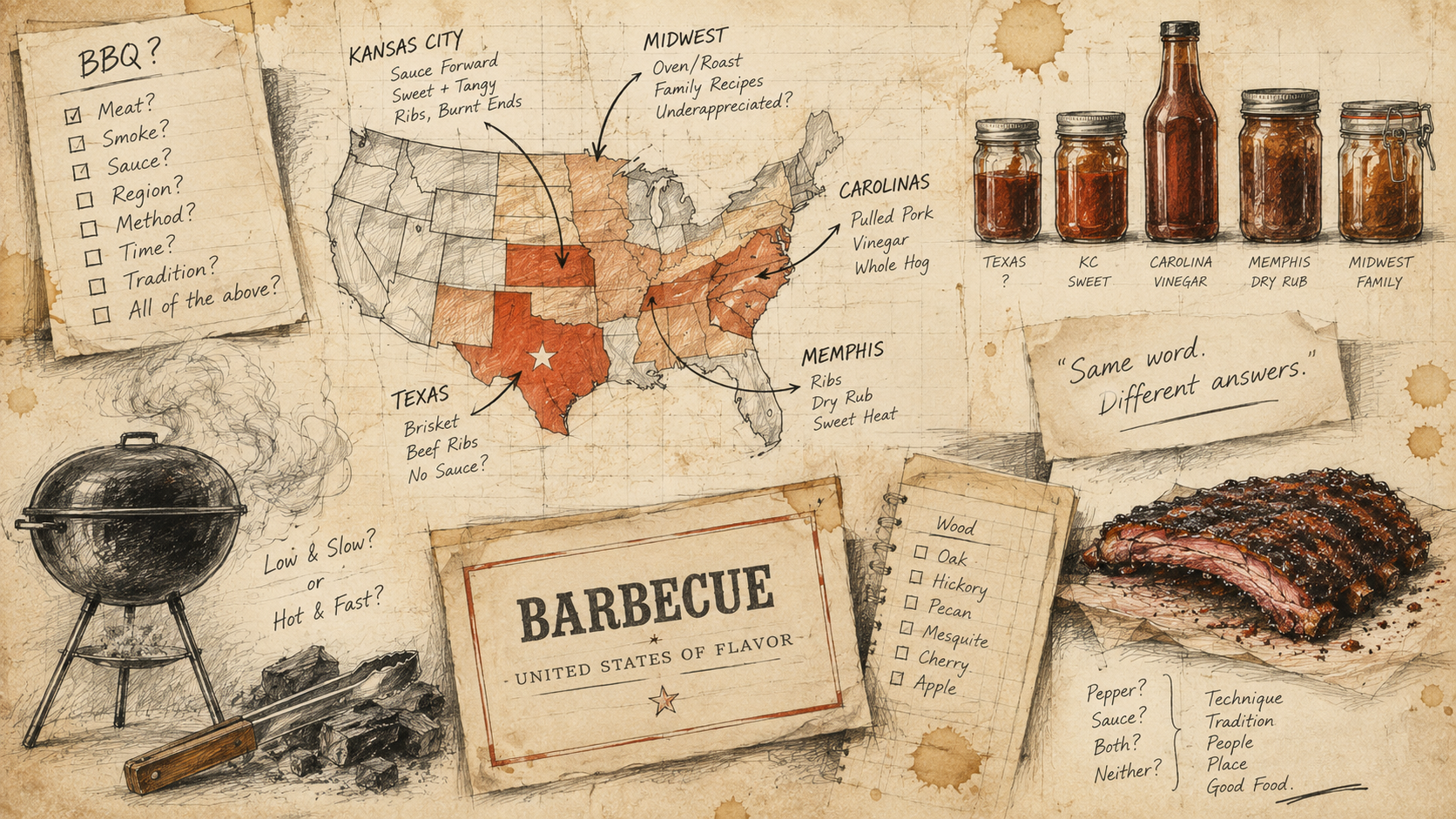
You would think that for someone planning to open a restaurant called G&C BBQ Company, I would have a pretty solid answer to a very basic question. All I have at this point is a Midwestern-style BBQ sauce recipe that has been passed down through generations, the "bake first, grill next" method my parents taught me, and hundreds of people that have given me rave reviews when I cook them. Admittedly, while that could be considered enough data, let's still dive in and set a foundation.
What exactly is BBQ?
Turns out, that's a much harder question than it sounds.
Ask ten people what barbecue is and there's a pretty good chance you'll get ten different answers. To one person, BBQ means a brisket that's been sitting in a smoker for 14 hours. To someone else, it's ribs slathered in a thick, sweet sauce. In the Carolinas, the conversation might immediately turn to pulled pork and vinegar. In Texas, suggesting that sauce is necessary at all might get you politely—or not so politely—shown the door.
And then there's my favorite complication: millions of Americans routinely announce that they're "having a barbecue" before throwing hamburgers and hot dogs on a gas grill.
Are they barbecuing?
I don't know.
But I do know there's probably no quicker way to start an argument among people who love BBQ than to try to define what counts as "real" barbecue.
Barbecue Isn't Grilling
Let's start with the relatively easy part.
Grilling and barbecuing aren't really the same thing.
When I throw a steak on a screaming-hot grill and cook it for a few minutes per side, I'm grilling. Same thing with burgers, hot dogs, chicken breasts, vegetables and just about anything else cooked relatively quickly over high heat.
Barbecue generally lives at the other end of the spectrum.
Lower temperatures. Longer cooking times. Usually indirect heat. And often—although this is where the arguments begin—smoke.
That distinction isn't just semantics. The two cooking methods are trying to accomplish fundamentally different things.
A great steak is already tender. I don't need to cook a ribeye for eight hours to make it edible. In fact, doing so would be a pretty effective way of ruining a perfectly good ribeye.
Traditional BBQ cuts are different.
Pork shoulder, brisket and ribs contain significant amounts of connective tissue. Give them enough time at the right temperature and something wonderful happens. Collagen begins breaking down into gelatin. Fat renders. Tough meat becomes tender, rich and succulent.
That's one of the things I love about BBQ. You're taking something that isn't necessarily the most naturally tender or expensive cut of meat and transforming it through technique, temperature and patience.
And I mean patience.
There aren't many shortcuts when you're waiting for a pork shoulder to decide it's finally ready to cooperate.
But Does BBQ Have to Be Smoked?
Now we get into dangerous territory.
There are plenty of BBQ purists who would answer this question without hesitation:
Yes. Absolutely. Next question.
I understand the argument.
Smoke is fundamental to many of America's great barbecue traditions. Texas brisket without wood smoke would certainly be a very different thing.
The choice between oak, hickory, pecan, mesquite, cherry and apple isn't incidental, either. Different woods produce different flavors. Managing the fire, controlling airflow and creating clean smoke are skills unto themselves.
But here's where I start causing trouble.
I'm not convinced smoke is what defines BBQ.
At least not entirely.
If I take a pork shoulder, season it, cook it slowly for hours until the collagen breaks down and the fat renders, pull it by hand, mix some of those wonderful juices back into the meat and serve it with BBQ sauce, did it suddenly stop being barbecue because I cooked it in an oven instead of over a wood fire?
Some people will say yes.
I'm not sure I agree.
And this isn't an academic question for me. It's something I'm going to have to answer before G&C ever opens its doors.
Roasting, Smoking and Braising
The more I cook, the more interested I become in what actually happens to food rather than what we're accustomed to calling the technique.
Take roasting and smoking.
Put a pork shoulder into a 250-degree oven and put another into a 250-degree smoker. From the meat's perspective, some remarkably similar things are happening. Heat is slowly working its way inward. Fat is rendering. Collagen is breaking down. Moisture is evaporating.
Obviously, there are differences. The smoker introduces smoke. Airflow may be different. Humidity may be different. The heat source is different.
Those differences can absolutely affect the final product.
But does one qualify as BBQ while the other doesn't?
Then consider braising. Put that same pork shoulder into a covered Dutch oven with some liquid and we've changed things again. We're now cooking in a much more humid environment. We'll get less evaporation and far less exterior crust, but we're still using time and heat to transform a tough piece of meat into something tender.
I've actually experimented with these differences while developing G&C's pulled pork. I've cooked pork shoulder in the oven, in a Dutch oven and in a slow cooker. They can all produce good pork.
But they don't produce the same pork.
That's the distinction I care about.
I'm much less interested in what we're allowed to call a technique than I am in figuring out which technique produces the food I want to serve.
Then There's the Sauce
Maybe BBQ is really about BBQ sauce.
Except that theory falls apart almost immediately.
Travel around America and the definition of BBQ sauce changes almost as dramatically as the meat itself.
Kansas City gave us the thick, sweet, tomato-forward sauce most Americans probably picture when they hear "BBQ sauce." Head east and you'll find thin vinegar sauces. South Carolina has its mustard-based tradition. Alabama famously puts a mayonnaise-based white sauce on chicken.
Texas?
Depending on where you are and whom you ask, putting sauce on a properly cooked brisket might be viewed as completely unnecessary.
Yet nobody seriously argues that Texas brisket isn't BBQ.
So sauce can't define it either.
There Isn't Even One BBQ Flavor
The same problem occurs with seasoning.
Some BBQ rubs contain a laundry list of ingredients: salt, pepper, paprika, garlic, onion, chili powder, cayenne, mustard powder, cumin, brown sugar and whatever secret ingredient someone swears they will take to the grave.
Then you get to Central Texas, where some spectacular BBQ can begin with little more than salt and coarse black pepper.
Sweet. Savory. Peppery. Spicy. Smoky. Tangy.
They're all BBQ.
Which is part of what makes this whole subject so interesting.
America didn't develop one barbecue tradition. We developed a bunch of them.
Texas became famous for beef and brisket. The Carolinas built traditions around pork. Memphis became known for ribs and pulled pork, including its famous dry ribs. Kansas City embraced different meats and that thick, sweet sauce. Alabama gave us white sauce.
Different meats. Different woods. Different sauces. Different seasonings. Different techniques.
And every region has people prepared to explain why theirs is the correct way to do it.
I kind of love that.
What Makes Great BBQ Great?
Maybe we're asking the wrong question.
Instead of asking what qualifies as BBQ, perhaps the more interesting question is:
What makes BBQ great?
For me, tenderness certainly matters. But tender isn't the same thing as overcooked.
Take ribs.
There are people who consider "fall-off-the-bone" the ultimate compliment. In competition BBQ circles, ribs that literally fall off the bone may be considered overcooked. The ideal bite has tenderness but still enough structure that you can bite cleanly through the meat without the entire rack collapsing.
Who's right?
Well, if you're the one eating the ribs, you are.
I'm increasingly convinced that's something we forget when talking about food. There can be technically correct ways of doing things, and there's enormous value in understanding them. But ultimately somebody has to eat the food.
If it isn't delicious, being technically correct isn't much consolation.
For me, great BBQ has to balance tenderness, moisture, rendered fat, seasoning, texture and sauce—or deliberately no sauce. If smoke is involved, it should complement the meat rather than overpower it.
And then there's the exterior.
Bark.
That dark, intensely flavored crust that develops on properly cooked BBQ can be extraordinary. Seasoning, rendered fat, dehydration, browning and smoke can all contribute to it. A great bite can give you that intensely seasoned exterior followed by juicy, tender meat underneath.
That's the kind of contrast I'm chasing.
Backyard BBQ and Restaurant BBQ Aren't the Same Thing
There's another part of this conversation that's especially important for me.
Making great BBQ at home and running a BBQ restaurant are two very different challenges.
At home, if my ribs take an extra hour, nobody cares very much. We eat an hour later.
Try explaining that to 100 restaurant customers.
At home I can obsess over one pork shoulder. A restaurant has to produce the same result over and over and over again.
Suddenly, consistency matters on an entirely different level. So do holding times, equipment capacity, labor, food safety, yield, waste, portion size and cost.
Cooking four racks of ribs is one thing.
Cooking 100 is another.
And producing rack number 100 so that it tastes exactly like rack number one is something else entirely.
That's one reason I'm giving myself years to figure this out.
Tradition Matters. But So Does Experimentation.
I'm fascinated by traditional BBQ.
I want to understand why Texas brisket developed the way it did. I want to understand Carolina pork, Memphis ribs and Kansas City sauce. I want to learn about the woods, rubs, pits and techniques behind them.
If generations of pitmasters have been doing something a certain way, there's probably a reason.
But I don't think respecting tradition requires blindly following it.
That's where the Test Kitchen comes in.
If conventional wisdom says ribs should be cooked at 225 degrees, I want to know what happens at 250. And 275. Maybe even 300.
If someone says I absolutely need a mustard binder, I want to cook two racks side by side and find out.
If I'm told meat has to be smoked to become great BBQ, I want to test that assumption too.
Foil or butcher paper?
Wrapped or unwrapped?
Spritz or don't spritz?
Sauce early or sauce late?
Smoke or oven?
Rest for 30 minutes or three hours?
I don't want to choose an answer because that's how someone told me BBQ is supposed to be made.
I want to taste the answer.
Sometimes tradition will win.
Sometimes the experiment will.
And sometimes I'll probably ruin a perfectly good piece of meat.
That's part of the fun.
So, What Exactly Is BBQ?
After all of that, you'd probably expect me to finally provide the definition.
I can't.
At least not yet.
I think BBQ is part cooking technique, part cuisine, part regional tradition and part culture. It's meat and heat and time. Sometimes it's smoke. Sometimes it's sauce. It's science, but it's also instinct. It's a brisket that's been tended all night and a rack of ribs somebody's dad has been making the same way every Fourth of July for 30 years.
More than anything, BBQ seems to be about transformation—taking relatively humble ingredients and using time, heat, seasoning and technique to turn them into something people gather around a table to eat.
That definition works pretty well for me.
For now.
Because the question I'm really trying to answer over the next several years isn't simply: What is BBQ?
It's:What should BBQ be at G&C?
I have the way my parents taught me, but I have some other ideas I want to try.
Now I need to cook them.
Tell us what you think.
The conversation is open. Pick the place you already use.