

WHAT WE TESTED.
- white Wisconsin curds
- craggy seasoned breading
- clean, hot fry
- white curds were more consistent
- the breading station needs room
- passed for the future BBQ Company menu
I think it's fair to say...
We did it.
After weeks of research, recipe development, and more planning than most people would ever imagine goes into fried cheese curds, our first real production test was a success.
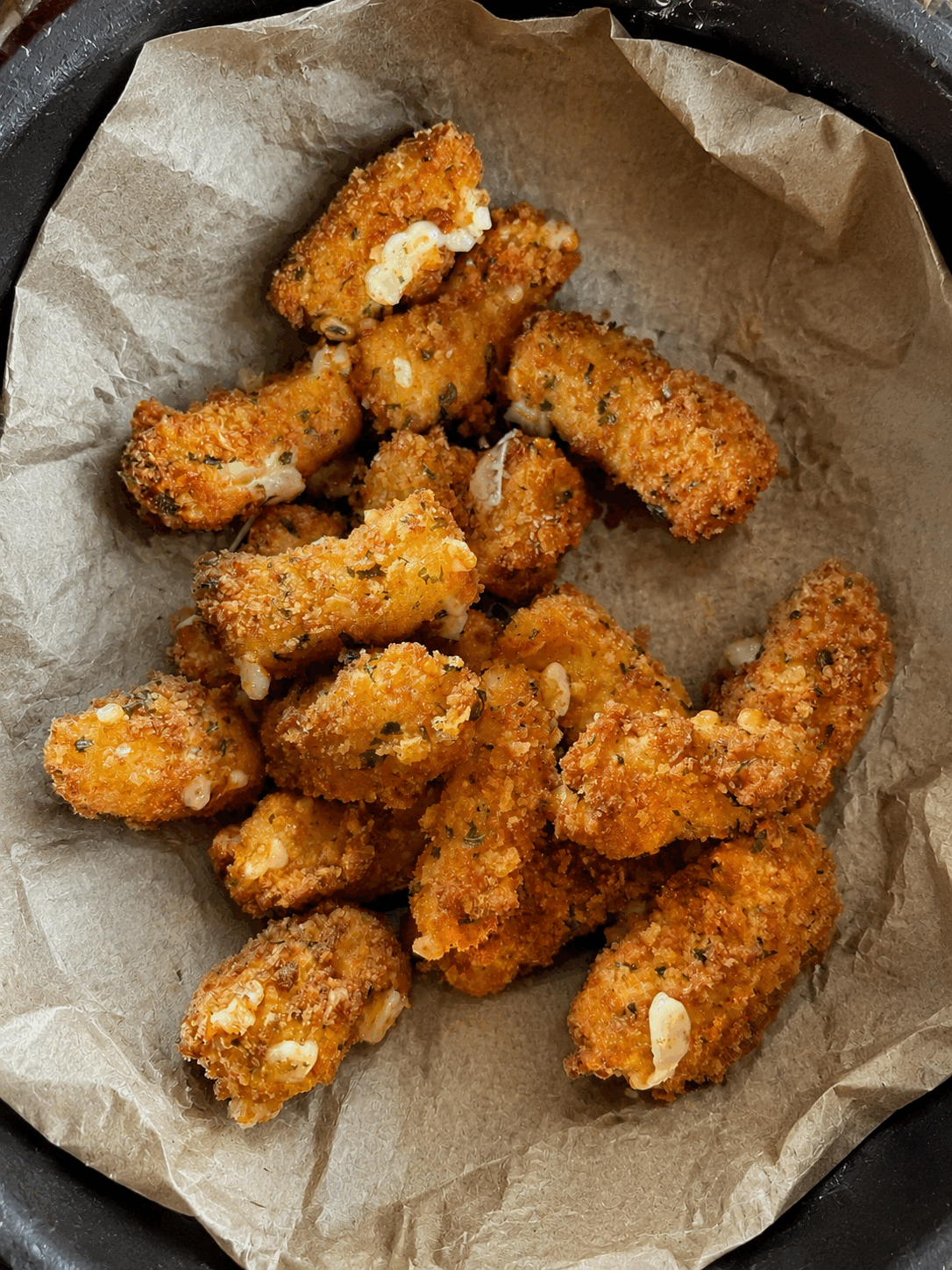
The curds came out exactly the way I had hoped—golden brown on the outside with a light, incredibly crispy shell surrounding warm, perfectly gooey Wisconsin cheese.
Could they be improved?
Of course.
Will they?
Absolutely.
But for a first attempt, I'm calling this one a win.
As always, though, the test taught me a few things.
WHITE CHEESE CURDS WIN... AT LEAST FOR NOW
One of my biggest questions going into this project was whether to serve white cheddar curds, yellow cheddar curds, or both.

After working with each of them, I think I've found my answer.
There's a reason most Wisconsin restaurants serve white cheese curds.
They're simply easier to work with.
The white curds were much more consistent in size, accepted the breading more evenly, and fried far more uniformly than their yellow cousins. The yellow curds weren't bad by any means, but their varying sizes made them a little less predictable during prep and in the fryer.

I'm not ready to completely rule them out…
But today, if I had to make the decision, I'd build the menu around white curds.
Sometimes tradition exists because it actually works better.
THE BREADING STATION LESSON
One thing I definitely underestimated was how much room breading cheese curds requires.
MY SETUP CONSISTED OF THREE BOWLS:
- Flour
- Egg wash
- Breadcrumb mixture
The flour worked perfectly in a bowl.
The egg wash worked perfectly in a bowl.
The breadcrumbs…
Not so much.
After coating enough curds, moisture inevitably found its way back into the breadcrumb bowl. Before long, my beautiful, fluffy breadcrumb mixture had become sticky and clumpy instead of coating each curd evenly.
Eventually, I gave up and started over with fresh crumbs.
Lesson learned.
Next time, I'm replacing the breadcrumb bowl with a large sheet pan. Having more surface area should help keep the crumbs loose and make it much easier to coat batches without contaminating the entire mixture.
Sometimes the best equipment upgrade costs almost nothing.
TWO MINUTES IS THE MAGIC NUMBER
One thing I don't plan on changing is the cooking time.
AFTER A FEW TESTS, THE SWEET SPOT TURNED OUT TO BE SIMPLE:
375°F FOR TWO MINUTES.
The results were exactly what I was hoping for.
A beautifully crisp exterior that shattered with every bite.
Warm, stretchy cheese inside.
No blowouts.
No undercooked centers.
Just...fried cheese curd perfection.
Sometimes the simplest answer is the right one.
THE GREAT SALT DEBATE
This one surprised me.
Normally, fried food gets seasoned immediately after it comes out of the fryer. The residual oil helps the salt adhere evenly across the surface.
So naturally, I tried both versions.
The salted curds were excellent.
But so were the unsalted ones.
The breading itself already carries a tremendous amount of flavor from the seasoning blend, Parmesan cheese, and herbs. Adding salt certainly made a difference, but it wasn't the dramatic improvement I expected.
I'm honestly still undecided.
This may end up being one of those details that gets settled only after serving hundreds of orders to real customers.
MAYBE THEY DON'T NEED EXTRA SEASONING
Originally, I planned to let guests toss their cheese curds in the same seasoning blends I'll be using on my fries and tater tots.
Now…
I'm not so sure.
The breading turned out so crispy and flavorful that additional seasoning might actually distract from what already works.
If the coating had been bland, the decision would have been easy.
Instead, I found myself wondering if adding more seasoning would simply be too much.
That's actually a nice problem to have.
AND THEN CAME THE DIPPING SAUCES…
This may have been the biggest surprise of the entire day.
A few weeks ago, I sampled each sauce with nothing more than the tip of a spoon.
They were all good.
Today…
They became something entirely different.
Take a hot, freshly fried cheese curd.
Dip it.
Now you're tasting the sauce the way it was meant to be eaten.
And wow.
Every single one of them came alive.
The cool creaminess of the Jalapeño Ranch.
The rich sweetness and smoky depth of the Smoked Tomato Jam.
The balance of sweet heat from the Hot Honey Mustard.
Each one transformed the curds into a completely different experience.
Choosing favorites was much harder than I expected.
THE WINNERS... AND THE ONES I'M RECONSIDERING
If I had to narrow the list today, two sauces still stand just a little taller than the rest.
The Jalapeño Ranch remains my favorite. It's thick, herbaceous, cool, and clings beautifully to the curds.
The Smoked Tomato Jam continues to surprise me every time I taste it. Sweet, smoky, savory—it almost feels like barbecue's answer to ketchup.
And honestly?
The Hot Honey Mustard deserves to be mentioned in the same breath. After increasing the heat during recipe development, it has become a fantastic companion to fried cheese.
The two sauces I'm reconsidering are the Horseradish Cream and the Roasted Garlic Aioli.
The horseradish version is good, but I suspect it won't become great until I can source fresh horseradish and grate it myself. Prepared horseradish simply doesn't deliver the same brightness or punch.
The garlic aioli presents a different challenge.
It's delicious.
But roasting enough garlic to keep up with restaurant demand takes a surprising amount of time. Every menu item has to justify the labor required to produce it, and I'm beginning to question whether this sauce earns its place.
Sometimes menu development isn't about flavor.
Sometimes it's about deciding where your time is best spent.
ONE MORE STEP CLOSER
This test felt like a milestone.
Fried cheese curds aren't just another appetizer in Wisconsin—they're a measuring stick. Every supper club, tavern, sports bar, and restaurant has their own version, and guests know exactly what they're looking for.
That makes the challenge even more exciting.
I'm not trying to reinvent Wisconsin cheese curds.
I'm trying to make a version worthy of being remembered.
The curds are officially on the future G&C BBQ Company menu.
PASS. KEEP BUILDING.
Tell us what you think.
The conversation is open. Pick the place you already use.