
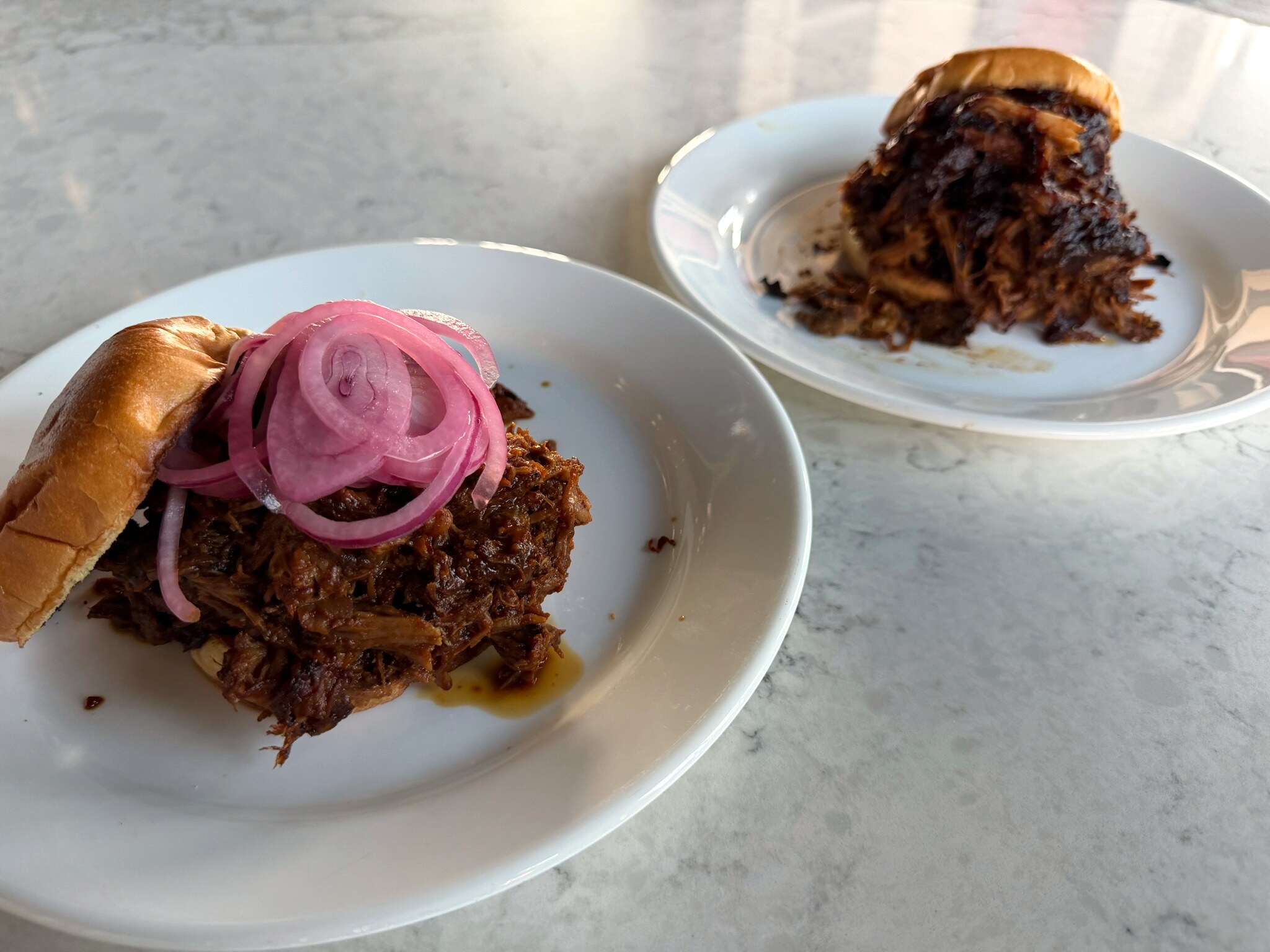

WHAT WE TESTED.
- 16.61 lb starting weight
- 9.5 lb finished yield
- 250°F slow cook
- juicy and easy to pull
- fat rendered into a remarkable jus
- two distinct sandwiches earned further work
One of the promises I've made to myself while building G&C BBQ Company is that I won't put anything on the menu simply because "that's how it's always done."
Every sandwich has to earn its place.
This week's experiment centered on one of the most iconic barbecue sandwiches there is: pulled pork.
I've made pulled pork at home more times than I can count, but this was the first time I approached it like I would in a restaurant. Documenting every step, comparing cooking methods, calculating yields, and - most importantly - asking which version I would actually want to serve to my guests.
TWO PORK SHOULDERS. TWO DIFFERENT METHODS.
The test began with two bone-in pork shoulders weighing a combined 16.61 pounds.

Rather than cooking them together, I wanted to answer a question I've had for years.
Which method is actually better?
One shoulder went into my Le Creuset Dutch oven at 250°F and reached perfection in about 7½ hours.
The second went into the slow cooker, where it spent roughly 24 hours at around 205°F before finishing in a 300° oven for the last 2½ hours.
Everything else stayed exactly the same.

Same pork.
Same seasoning.
Same finishing process.
In fact, I used the exact same rub and cooking jus recipe that I developed for the Oconomowoc Brisket Stack.
That's intentional.
One thing you'll notice throughout the G&C BBQ menu is consistency. Different meats shouldn't taste identical, but I want guests to recognize a familiar flavor profile that ties the entire menu together.
After cooking, both shoulders rested for about an hour before I pulled the meat.
THE OVEN WAS THE CLEAR WINNER
I honestly expected the slow cooker to dominate this test.
After all, twenty-four hours sounds impressive.
Instead, the Dutch oven surprised me.
The pork shredded beautifully while still retaining little pockets of roasted fat that practically melted into the meat.
It was incredibly juicy, incredibly flavorful, and had just enough roasted character that I don't think the slow cooker could replicate.
That's not to say the slow cooker version was bad.
Far from it.
It shredded nicely and would make excellent pulled pork.
But if I were serving someone their first sandwich at G&C BBQ Company, I'd choose the oven-roasted version every single time.
It also wins on practicality.
Restaurant kitchens don't have the luxury of tying up equipment for twenty-four hours if a seven-and-a-half-hour process produces an even better product. Less labor, lower energy costs, more scheduling flexibility, and, in my opinion, a better sandwich.
Sometimes the simpler answer really is the better one.
THE HARDEST PART WAS WAITING
Once both pork shoulders came out of the oven, I wasn't finished.
In fact, one of the most important steps was still ahead.
Waiting.
It's incredibly tempting to start pulling pork the moment it comes out of the oven. The aroma fills the kitchen, the meat looks unbelievably tender, and all you want to do is dive in. But if you do, you'll quickly discover two problems. First, it's simply too hot to handle. Second, all of those flavorful juices are still racing around inside the meat.
Instead, I let both pork shoulders rest for about an hour.
By the time they had cooled enough for me to comfortably handle them with my bare hands, something else had happened. The juices had redistributed throughout the meat, making every handful noticeably more moist and flavorful.
Pulling the pork by hand also gives you a level of control that forks or mechanical shredders simply can't match. You can feel the grain of the muscle, separate the meat into long, tender strands, remove any unwanted pieces of fat or connective tissue, and intentionally leave behind the rich, buttery bits that make pulled pork so special.
It also helps preserve the texture.
Good pulled pork shouldn't look like it came out of a food processor. It should have long, distinct strands of meat with just enough variation to remind you that it came from a whole pork shoulder that spent hours slowly transforming into something extraordinary.
Yes, waiting an hour adds time to the process.
But compared to the seven-and-a-half hours spent roasting the pork, it's a small investment that pays dividends in both flavor and texture. Like so many things I've discovered while building G&C BBQ Company, patience isn't just a virtue.
Sometimes it's an ingredient.
YIELD MATTERS
The two shoulders produced about 9½ pounds of finished pulled pork.
That's actually an excellent yield once you account for rendered fat, moisture loss, and the bones.
Still, it was another reminder that menu pricing isn't based on the weight you buy.
It's based on what actually ends up on the plate.
Right now, my plan is to serve an eight-ounce portion on every sandwich.
It's generous.
It's satisfying.
And it gives guests exactly the kind of value I want G&C BBQ Company to become known for.
THEN CAME THE BIGGEST SURPRISE OF THE DAY
This is where the experiment completely changed directions.
I prepared two identical eight-ounce portions.
The first received just a quarter cup of the cooking jus.
The second received a quarter cup of my family BBQ sauce.
I've always mixed barbecue sauce directly into pulled pork.
Always.
So naturally, I assumed that version would win.
It didn't.
Not even close.
The pork finished with only its own cooking jus was absolutely incredible.

The flavor of the pork finally became the star.
The meat tasted richer.
Cleaner.
More natural.
There was still a subtle barbecue flavor because some of the seasoning and sauce had found their way into the cooking liquid, but it wasn't overwhelming.
Instead of tasting barbecue sauce…
...it tasted like exceptional pork.
The BBQ sauce version was still delicious.

In fact, if you'd handed it to me a week ago, I probably would have called it perfect.
But after tasting the jus version…
I couldn't stop going back to it.
TOPPINGS CHANGED EVERYTHING
Of course, the next question became…
What belongs on this sandwich?
I tried the BBQ sauce version plain.
Then with my house-made pickled red onions.
The onions were fantastic.
They added crunch, brightness, and enough acidity to balance the richness of the pork.
Then I repeated the experiment with the jus version.
Again, the pickled onions were outstanding.
Finally, I substituted my house-made dill pickles.
That version didn't work nearly as well.
The pickles completely overpowered the pork.
Which led to another unexpected realization.
DOES THIS SANDWICH EVEN NEED AN AIOLI?
One of the debates that followed our tasting session had nothing to do with the pork.
It was about what shouldn't be on the sandwich.
Originally, I assumed we'd end up with some type of aioli. Garlic aioli is popular. Dijon aioli worked incredibly well on the Oconomowoc Brisket Stack. It seemed only natural that the pulled pork sandwich would need its own signature spread.
Then we started tasting.
First, just the pork.
Then the pork with the roasting jus.
Then with pickled red onions.
Then with BBQ sauce.
After several bites, one thing became obvious.
The sandwich didn't feel like it was missing anything.
That's actually a rare conclusion in recipe development. Usually you're searching for that one final ingredient that ties everything together. This time, every additional idea seemed to move us farther away from what made the sandwich special in the first place.
The pork is incredibly juicy on its own.
The roasting jus adds richness without masking the meat.
The pickled onions contribute brightness and crunch.
Adding an aioli might introduce creaminess, but it also risks coating your palate and muting the roasted pork flavor that took hours to develop.
That doesn't mean the idea is dead.
Far from it.
I'll continue experimenting with different aiolis and other spreads because that's what the G&C Test Kitchen is all about. Maybe there's a version that elevates the sandwich without competing with it.
But today, the leading candidate is actually…
Nothing.
Sometimes the hardest decision in cooking isn't deciding what to add.
It's deciding when you've already arrived.
HAVE I BEEN THINKING ABOUT PICKLES ALL WRONG?
Earlier that same day I had made another fresh batch of my house-made dill pickles.
They're exactly what I hoped they'd become.
Aggressive.
Bold.
Crunchy.
They're the kind of pickle that immediately gets your attention.
And that may actually be the problem.
They're so flavorful that they risk becoming the main event instead of supporting the sandwich.
So now I'm wondering if they belong on the sandwich at all.
Maybe every sandwich simply comes with half of one of these giant house-made pickles on the side.
People who love pickles would be thrilled.
People who don't can simply leave it untouched.
Operationally, it's inexpensive.
Marketing-wise, it could become one of those little signature touches that people remember long after they've left.
That's an idea worth exploring.
THE COLESLAW DEBATE
No pulled pork discussion is complete without talking about coleslaw.
Many barbecue purists will tell you that a pulled pork sandwich isn't complete unless the southern-style slaw goes right on top.
I understand that.
But I'm not convinced that's the experience I want every guest to have by default.
Instead, I'm seriously considering serving a small three- or four-ounce cup of house-made coleslaw alongside the sandwich.
Guests who love slaw can pile it on themselves.
Guests who don't can enjoy it as a side.
It keeps the sandwich cleaner.
It respects both preferences.
And it gives guests another scratch-made item to enjoy.
DO I ACTUALLY HAVE TWO SANDWICHES?
When I finished cleaning the kitchen, I realized I hadn't answered my original question.
Instead, I'd stumbled onto a completely different one.
Did I accidentally create two signature pulled pork sandwiches?
One celebrates traditional barbecue with my family recipe sauce.
The other lets beautifully roasted pork speak almost entirely for itself, enhanced only by its own cooking jus.
They're different experiences.
Neither is wrong.
And honestly…
I don't know which one I like more.
That's exactly why I love building this restaurant.
Sometimes you set out looking for one answer.
Instead, you discover something you never expected.
Those are usually the days that shape the menu the most.
PASS. KEEP BUILDING.
Tell us what you think.
The conversation is open. Pick the place you already use.